

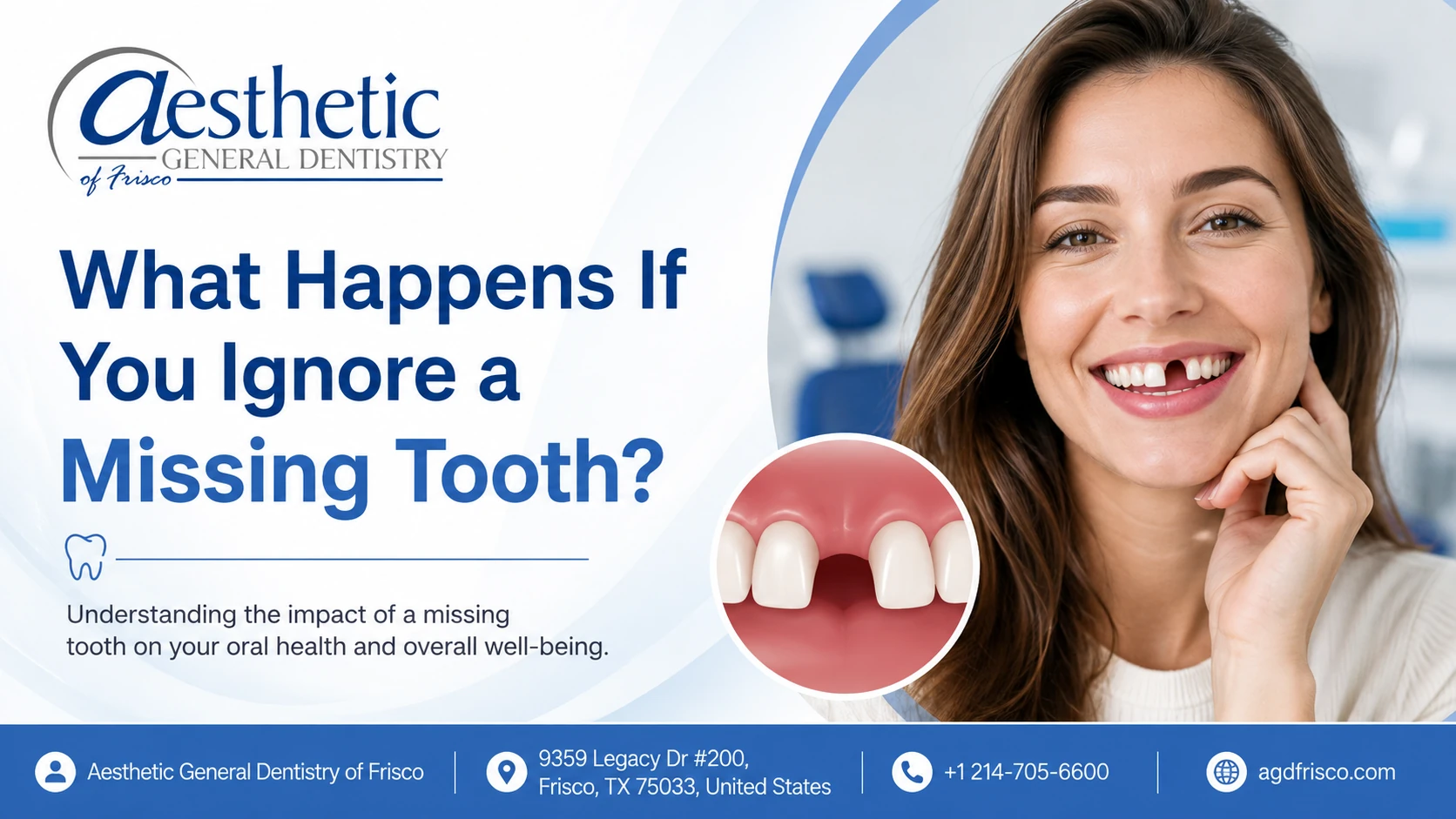
Losing a tooth does not always create an immediate problem. If the gap is toward the back of your mouth and is not visible when you smile, you might even wonder whether replacing it is necessary.
However, a missing tooth can affect more than appearance. Depending on which tooth is missing, your bite, surrounding teeth, chewing patterns, gums, and the bone in the area can gradually change. The American Dental Association notes that remaining teeth may shift after tooth loss, chewing can be affected, and bone loss can occur around a missing tooth.
That does not mean every missing tooth will cause the same problems or that changes happen according to a predictable schedule. Your oral health, anatomy, bite, number of missing teeth, and location of the gap all matter.
At Aesthetic General Dentistry, we encourage patients to have a missing tooth evaluated even if it is not currently uncomfortable. An examination can help determine whether replacement is recommended and which options make sense for your individual situation.
What Happens If You Leave a Missing Tooth Untreated?
When a tooth is removed or lost, the space it occupied remains part of a larger system involving the neighboring teeth, opposing teeth, jawbone, muscles, and bite.
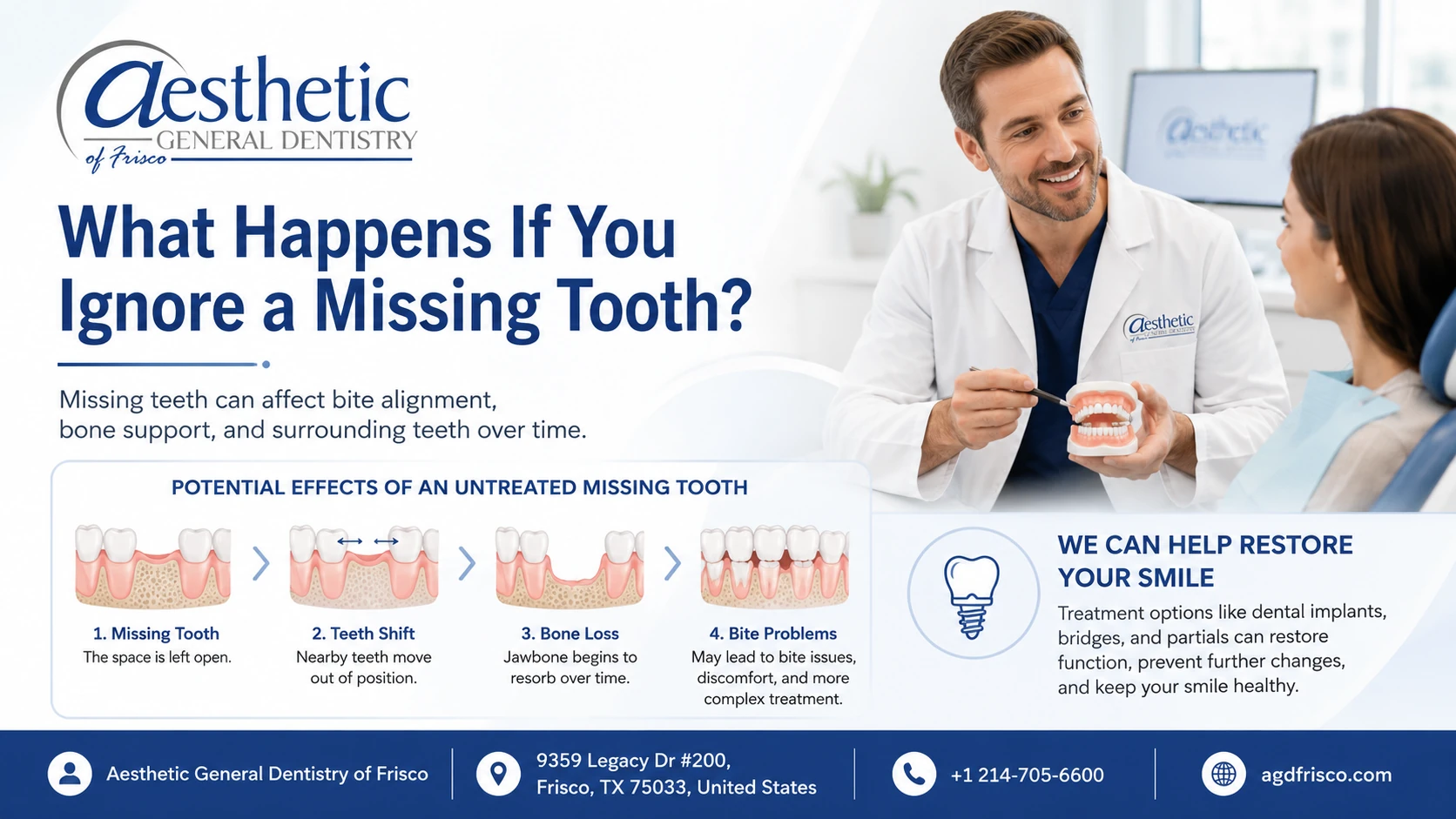
Over time, several changes may occur:
- Neighboring teeth may shift toward the open space.
- Your bite may change.
- Chewing may become less efficient on that side.
- Other teeth may take on different chewing forces.
- Bone in the missing-tooth area may gradually change.
- Food may become easier to trap around the gap or shifted teeth.
- Speech can sometimes be affected, particularly when several teeth or certain front teeth are missing.
The ADA specifically notes that gaps from missing teeth can affect eating or speaking and that even a missing molar can influence chewing.
How much these changes matter depends on your specific mouth. One missing tooth does not automatically create every possible consequence.
That is why early evaluation is more useful than assuming either that the tooth must immediately be replaced or that leaving it alone will never cause a problem.
Can Nearby Teeth Shift Into the Empty Space?
Yes, neighboring teeth may gradually move toward an open space.
Teeth normally contact one another and function together as part of the bite. Once a tooth is gone, the neighboring teeth no longer have the same contact and support on that side.
The ADA lists shifting of remaining teeth as one possible consequence of missing teeth.
Movement can potentially create:
- New gaps between teeth
- Crowding
- Changes in tooth angulation
- Bite changes
- Areas where food becomes easier to trap
- More complicated future replacement planning
The tooth opposite the gap may also experience changes because it no longer contacts its former partner in the same way during chewing.
Not every patient’s teeth move significantly, and there is no universal timeline for when movement occurs.
However, if replacement is being considered, evaluating the space earlier can help your dentist understand the current alignment before additional changes develop.
Does a Missing Tooth Cause Jawbone Loss?
Bone can gradually change after a tooth is lost.
Natural tooth roots transfer forces into the jaw during everyday biting and chewing. Once a tooth and its root are gone, the bone in that specific area no longer receives the same type of stimulation.
The ADA notes that bone loss can occur around a missing tooth.
This process is important when discussing future replacement options because the amount and shape of available bone can influence treatment planning, particularly for dental implants.
However, bone changes vary substantially among patients. Factors such as:
- Location of the missing tooth
- Number of missing teeth
- Existing bone anatomy
- Gum health
- How the tooth was lost
- Length of time the tooth has been absent
- Overall health
can influence what happens.
You should not assume that losing one tooth means severe bone loss will inevitably occur. Instead, your dentist can evaluate the area clinically and with appropriate imaging when necessary.
Can a Missing Tooth Change Your Bite?
It can.
Your bite depends on how the upper and lower teeth contact and distribute pressure.
When one tooth is removed from that system, nearby teeth may shift and chewing patterns can change. If those changes become significant, the way your teeth come together may feel different.
You may begin:
- Favoring one side when chewing
- Putting additional pressure on certain teeth
- Avoiding the missing-tooth area
- Noticing new spaces or changes in alignment
These changes do not necessarily happen immediately.
A missing front tooth may affect the bite differently from a missing molar because each tooth has a different job.
If you have lived with a missing tooth for some time, your dentist will generally assess your current bite as part of replacement planning rather than assuming it remains exactly as it was before the tooth was lost.
How Can Missing Teeth Affect Chewing and Eating?
The effect on chewing depends greatly on which tooth or teeth are missing.
Molars and premolars perform much of the grinding involved in chewing food. Losing one of these teeth can reduce the available chewing surface on that side.
The ADA specifically points out that a missing molar can affect chewing.
Some patients naturally begin chewing more heavily on the opposite side.
If that becomes a long-term habit, the remaining teeth may handle a different distribution of chewing forces than before.
Several missing teeth can create a more noticeable functional change. Certain foods may become more difficult to break down, and people may adjust what or how they eat.
Dentures and other tooth-replacement options are designed in part to restore chewing function. The ADA notes that dentures can make eating easier for people who have lost multiple or all of their teeth.
Can Missing Teeth Affect Your Remaining Teeth?
Potentially, yes.
A gap changes the environment surrounding the remaining teeth.
Nearby teeth may shift, while other teeth may take on additional chewing responsibilities. Changes in spacing can also create areas that are more difficult to clean effectively.
The effect varies according to the number and location of missing teeth.
For example, losing a single tooth between two otherwise healthy teeth creates a different situation from losing several back teeth on the same side.
The condition of your remaining teeth also matters.
If surrounding teeth already have:
- Large fillings
- Crowns
- Gum disease
- Wear
- Cracks
- Significant bite stress
your dentist may take those conditions into account when recommending how to restore the missing space.
Replacement planning should therefore consider the entire mouth rather than viewing the gap in isolation.
Does It Matter Where the Missing Tooth Is Located?
Yes. Location can significantly affect what you notice and how your dentist approaches replacement.
Missing Front Teeth
Front teeth play major roles in appearance, speech, and biting into foods.
A missing front tooth may therefore create an immediate cosmetic concern and can sometimes affect speech or function.
Missing Premolars
Premolars contribute to both tearing and grinding food. Their visibility also depends on the position of the tooth and the width of your smile.
Missing Molars
A missing back tooth may not be easily visible, which sometimes leads patients to believe it is less important.
However, molars perform much of the heavy chewing work in the mouth. The ADA specifically notes that missing molars can affect chewing even when the space is not noticeable.
Multiple Missing Teeth
The effects become more complex as more teeth are lost.
When many or all teeth are missing, chewing, speech, facial support, and the distribution of biting forces may all be affected. Dentures are one option for replacing multiple missing teeth, and implants may also be incorporated into certain treatment plans.
How Quickly Should You Replace a Missing Tooth?
There is no universal rule that every missing tooth must be replaced immediately.
What is appropriate depends on why the tooth was lost and what is happening elsewhere in the mouth.
For example, treatment planning may need to account for:
- Healing after an extraction
- Existing gum disease
- Infection
- Bone condition
- Orthodontic treatment
- Neighboring teeth
- Overall medical health
- The specific replacement being considered
However, it is generally helpful to have the area evaluated early, even if replacement does not happen immediately.
Early evaluation allows your dentist to assess the available space, neighboring teeth, bite, gum condition, and bone before significant changes potentially develop.
If you are considering an implant, early planning can be particularly useful because implants depend on appropriate bone and overall health. The ADA explains that dental implants are surgically placed into the jaw and rely on the surrounding bone for support.
The goal is not to pressure every patient into immediate treatment. It is to understand your options before the situation becomes more complicated.
What Are Your Options for Replacing a Missing Tooth?
Several treatment options are available, and the best choice depends on the number and location of missing teeth, the condition of your remaining teeth, your bone and gum health, budget, preferences, and overall treatment goals. Patients comparing missing teeth replacement options in Frisco, TX may consider implants, bridges, dentures, and other restorative approaches based on their individual needs.
The ADA identifies three common categories for replacing missing teeth: bridges, dentures, and dental implants.
Dental Implants
An implant uses a post placed in the jawbone to support a replacement tooth or teeth.
Dental Bridges
A bridge fills the space created by one or more missing teeth and generally uses surrounding teeth for support. The ADA describes a fixed bridge as a restoration that literally bridges the gap between remaining teeth.
Dentures
Dentures are removable prosthetic teeth. Depending on the situation, they can replace several teeth or an entire arch.
The appropriate choice is not based solely on which option is most permanent or most affordable. Your dentist needs to consider the health and function of the entire mouth.
How Can Dental Implants Help Replace Missing Teeth?
Dental implants are designed to replace missing teeth using support from the jawbone.
The implant itself is surgically placed into the upper or lower jaw. During healing, the surrounding bone integrates with the implant in a process called osseointegration. A crown, bridge, or other restoration can then be supported by the implant depending on the treatment plan.
For a single missing tooth, an implant may provide an independent replacement without requiring the neighboring teeth to support a conventional bridge.
However, implants are not automatically appropriate for every patient.
Your dentist must consider factors such as:
- Bone availability
- Gum health
- Medical history
- Healing ability
- Tobacco use
- Location of the missing tooth
- Bite forces
- Overall oral health
The ADA notes that general health can be an important factor when determining implant suitability and that certain medical conditions or tobacco use may affect healing.
An examination and appropriate imaging are necessary to determine whether implant treatment is a reasonable option.
When Are Dentures an Option for Missing Teeth?
Dentures become particularly relevant when multiple teeth or all teeth need to be replaced.
A partial denture can replace several missing teeth while remaining natural teeth are still present.
A complete denture replaces an entire arch when all natural teeth in that arch are missing.
The ADA describes dentures as removable appliances that replace missing teeth and can help patients eat and speak more effectively than they could without teeth.
Dentures may also be combined with dental implants in certain treatment plans to improve stability and support.
Whether dentures are appropriate depends on:
- How many teeth are missing
- Where the gaps are located
- Condition of remaining teeth
- Gum and bone anatomy
- Functional needs
- Patient preferences
- Budget and treatment goals
Like any dental restoration, dentures also require ongoing cleaning, maintenance, and professional follow-up.
What Frisco Patients Should Know About Missing Tooth Replacement
If you have a missing tooth in Frisco, you do not need to decide between an implant, bridge, or denture before seeing your dentist.
The first priority is understanding the condition of your mouth.
At Aesthetic General Dentistry, we can evaluate the missing-tooth area along with your neighboring teeth, gums, bite, and available bone. That information helps determine whether replacing the tooth is recommended and which options deserve consideration.
A missing tooth may seem like an isolated issue, particularly when it is toward the back of the mouth. However, the ADA confirms that missing teeth can affect chewing, allow surrounding teeth to shift, and sometimes be associated with bone changes.
Those possibilities do not mean every patient will experience the same progression.
Some situations require relatively prompt treatment. Others allow time for healing, monitoring, or additional dental care before a permanent replacement is completed.
The most useful approach is to have the area evaluated while you still have the widest range of information and treatment choices available.
Replacing a missing tooth should ultimately be about maintaining comfortable function and long-term oral health, not simply filling an empty space.
FAQs
Do you always have to replace a missing tooth?
Not necessarily. Whether replacement is recommended depends on the location of the tooth, your bite, neighboring teeth, oral health, and other clinical factors. However, the area should be evaluated because missing teeth can contribute to shifting, chewing changes, and bone changes in some patients.
Will teeth shift if I leave a gap?
They can. The ADA notes that remaining teeth may shift after a tooth is lost. The amount and timing of movement vary from person to person.
Does every missing tooth cause bone loss?
Not every patient experiences the same amount of change, but bone loss can occur in the area of a missing tooth. Your dentist can evaluate the bone if replacement, particularly an implant, is being considered.
Can one missing tooth affect chewing?
Yes. The effect depends on the tooth. A missing molar, for example, can affect chewing even though it may not be visible when you smile.
Does a missing back tooth really need attention?
Yes, it should at least be evaluated. Back teeth play an important role in grinding food and maintaining the bite. Whether the tooth should be replaced depends on your individual situation.
How long can I wait before replacing a missing tooth?
There is no single safe waiting period for everyone. Healing, bone condition, neighboring teeth, gum health, and the planned replacement all influence timing. Early evaluation can help your dentist create an appropriate treatment plan.
What is the best way to replace one missing tooth?
Dental implants and bridges are common possibilities for replacing a single tooth. Which is preferable depends on your bone, neighboring teeth, oral health, treatment preferences, and other factors.
Can dentures replace only a few missing teeth?
Yes. Partial dentures can replace one or more missing teeth when some natural teeth remain. Complete dentures are generally used when all teeth in an arch are missing.
Can dental implants prevent changes in the missing-tooth area?
Implants are placed directly into the jawbone and provide bone-supported replacement teeth. Whether an implant is appropriate depends on available bone, gum health, medical suitability, and other clinical factors.
Is a dental bridge an alternative to an implant?
Yes. A bridge can replace one or more missing teeth by spanning the gap and using surrounding teeth or, in some designs, implants for support.
What if my missing tooth does not hurt?
A missing tooth itself may cause no pain. That does not tell you whether shifting, bite changes, or bone changes are occurring. A dental examination can determine whether monitoring or replacement is appropriate.
When should I see a dentist about a missing tooth?
It is a good idea to schedule an evaluation after losing a tooth or when you begin considering replacement. Your dentist can assess healing, the neighboring teeth, bite, gums, and bone before recommending implants, bridges, dentures, or another plan.