

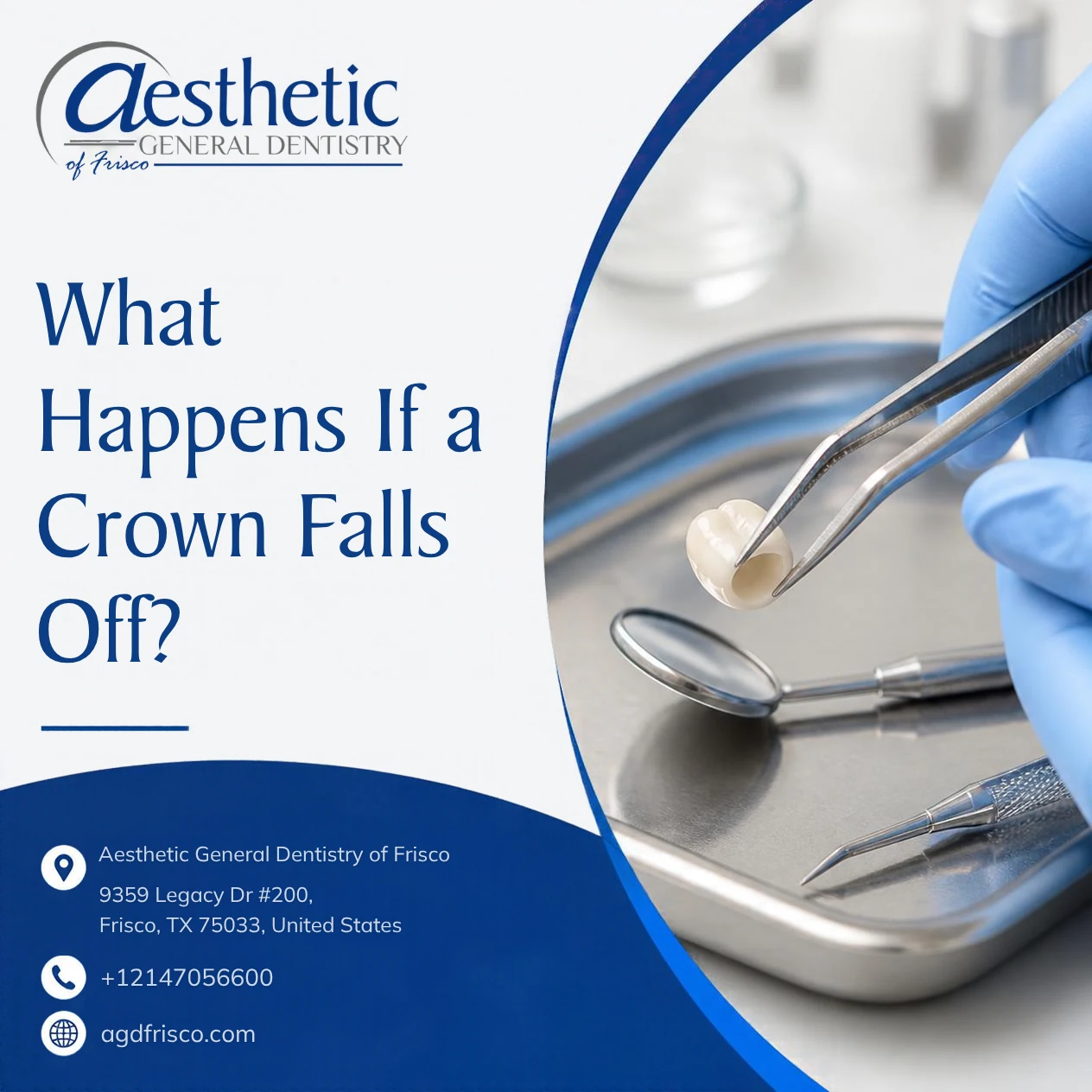
If a dental crown falls off, the tooth underneath may become sensitive, uncomfortable, or more vulnerable to damage. The safest response is to save the crown if possible, avoid chewing on that side, keep the area clean, and contact your dentist promptly.
A lost crown does not always mean the tooth is severely damaged, and the restoration may sometimes be recemented. However, the dentist needs to examine both the crown and the underlying tooth first. Avoid household glue or other permanent do-it-yourself fixes, because they can damage the tooth, interfere with treatment, or make the crown harder to restore properly.
What Happens If a Dental Crown Falls Off?
When a crown comes off, the natural tooth underneath is no longer protected in the way it was intended to be.
Depending on how the tooth was prepared and why the crown came loose, you may notice:
- Cold sensitivity
- Sensitivity to heat or sweets
- Tenderness while chewing
- A rough or unusual tooth shape
- A visible gap where the crown used to be
- Food collecting around the area
- Little or no discomfort at all
Some crowned teeth have had root canal treatment and may not be sensitive to temperature. Others still contain healthy dental pulp and can become noticeably sensitive when exposed.
The important point is that a missing crown should be evaluated even if the tooth does not hurt.
A crown can fall off because the cement failed, but it may also come loose because something has changed underneath the restoration.
What Should You Do Immediately If Your Crown Comes Off?
First, remove the crown from your mouth if it is loose enough to swallow or inhale accidentally.
Then take a few practical steps to protect the tooth.
1. Find and Save the Crown
If you can locate the restoration, place it somewhere clean and secure.
Do not throw it away.
Your dentist may be able to reuse it if the crown and underlying tooth remain in suitable condition.
2. Rinse Your Mouth Gently
Rinse with water to remove food particles or debris.
Avoid aggressive rinsing if the gum or tooth is tender.
3. Look at the Tooth Without Picking at It
You can check whether part of the tooth appears broken, but avoid probing the area with sharp objects.
Do not try to scrape cement off the tooth or inside the crown.
4. Avoid Chewing on That Side
The exposed tooth may be more vulnerable to fracture.
Choose softer foods and chew on the opposite side until your dentist evaluates the area.
5. Contact Your Dentist
Call the dental office and explain that a crown has fallen off.
Mention whether:
- You have pain
- The tooth appears broken
- There is swelling
- The crown is intact
- The crown came off after an injury
The office can determine how quickly you should be seen.
Should You Save the Crown?
Yes. Save the crown whenever possible.
Place it in a small clean container or sealed bag and bring it to your dental appointment.
A dentist can examine:
- The inside of the crown
- The crown margins
- Remaining cement
- The condition of the tooth
- The fit of the restoration
Do Not Try to Alter the Crown
Avoid:
- Filing it
- Scraping the inside
- Grinding an edge
- Bending any component
- Removing material with a sharp tool
Even a small change could affect how the crown fits.
Do Not Use Household Glue
Never use super glue, craft glue, or another household adhesive.
These products are not designed for use inside the mouth and can:
- Irritate oral tissues
- Damage the tooth
- Prevent proper crown seating
- Make professional removal more difficult
- Interfere with future bonding or cementation
If you are uncertain what to do before your appointment, call the dental office rather than improvising a permanent repair.
Can You Eat With a Missing Crown?
You can usually eat while waiting for dental care, but you should be cautious.
The exposed tooth may be weaker or more sensitive than a normal untreated tooth.
Choose Softer Foods
Temporary choices may include:
- Eggs
- Yogurt
- Soft pasta
- Rice
- Soup that is not extremely hot
- Soft vegetables
- Fish
- Mashed potatoes
- Oatmeal
Try to chew away from the affected area.
Avoid Hard Foods
Hard foods may fracture the exposed tooth.
Be particularly careful with:
- Ice
- Hard candy
- Nuts
- Popcorn kernels
- Hard crusts
- Raw hard vegetables
Avoid Sticky Foods
Sticky foods may pull on remaining cement or interfere with the exposed tooth.
Examples include:
- Caramel
- Taffy
- Sticky candy
- Chewing gum
Be Careful With Extreme Temperatures
A tooth without its crown may become sensitive to very hot or cold foods.
Choosing moderate temperatures may make eating more comfortable until the tooth can be treated.
What Risks Can Happen If You Delay Treatment?
A crown that has fallen off should not usually be ignored for weeks or months.
The longer the tooth remains unprotected, the more opportunities there may be for additional problems.
Tooth Fracture
Many crowned teeth already have substantial fillings, previous damage, or reduced natural tooth structure.
Without the crown, the remaining tooth may be more vulnerable to breaking during chewing.
Tooth Decay
Plaque and food can collect around the exposed tooth.
If decay develops or was already present underneath the crown, delaying treatment may allow it to progress.
Increased Sensitivity
Exposed dentin may become sensitive to:
- Cold
- Heat
- Sweets
- Pressure
The symptoms may become more noticeable if the tooth remains uncovered.
Tooth Movement
Teeth can shift over time when contact relationships change.
Even small movements could make it more difficult for the old crown to fit properly later.
Gum Changes
Gum tissue may shift or grow into areas around the prepared tooth.
This can complicate crown replacement or recementation.
More Extensive Treatment
A crown that could have been recemented initially may eventually require replacement if the tooth or restoration changes.
If the tooth fractures or develops severe decay, more extensive treatment could become necessary.
Why Do Dental Crowns Fall Off?
Crowns can loosen for several reasons.
Sometimes the problem is primarily with the cement. Other times, the crown comes off because the tooth or restoration has changed.
Common causes include:
- Cement deterioration
- Tooth decay underneath the crown
- Biting hard foods
- Chewing sticky foods
- Teeth grinding or clenching
- A damaged crown
- A fractured tooth
- Insufficient remaining tooth structure
- Wear over many years
- Changes in the bite
Cement Can Lose Its Hold
Dental cement is designed to retain the crown, but no restoration lasts forever.
Over time, the bond can weaken.
If the crown and tooth remain healthy, recementation may sometimes be possible.
Decay Can Affect Crown Retention
A crown cannot develop a cavity, but the natural tooth underneath can.
Decay around the crown margin may weaken the tooth and change its shape.
If enough tooth structure is lost, the crown may no longer fit securely.
Grinding Can Stress the Crown
Clenching and grinding repeatedly place heavy force on teeth and restorations.
Over time, that stress can contribute to:
- Crown loosening
- Chipping
- Cracks
- Tooth fracture
If grinding contributed to the problem, your dentist may also discuss strategies for managing those forces.
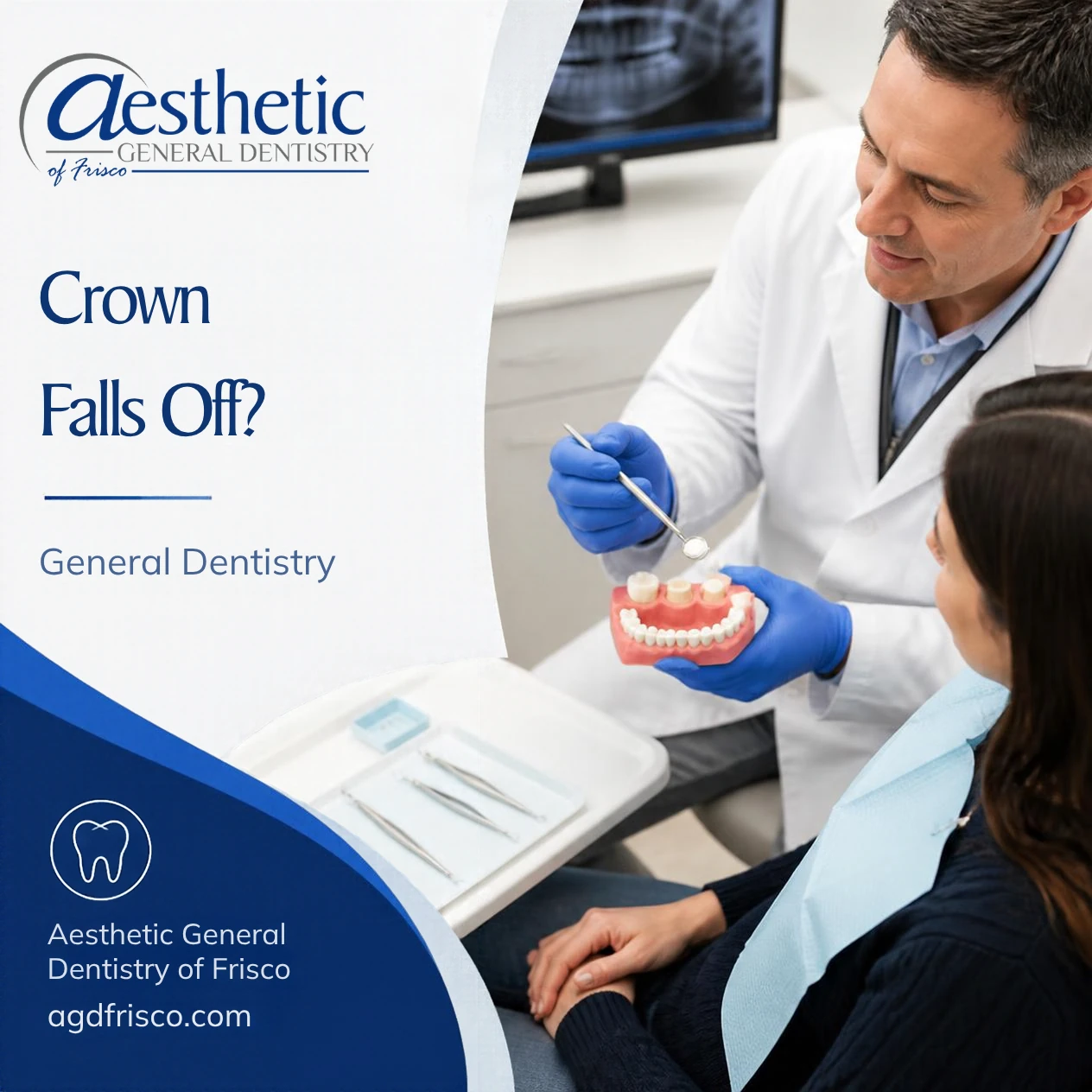
Can a Fallen Crown Be Recemented?
Sometimes.
If the crown is intact, still fits properly, and the tooth underneath remains healthy enough, the dentist may be able to clean the restoration and recement it.
Before doing so, the dentist needs to determine why it came off.
Recementation May Be Possible When
- The crown is undamaged
- The tooth has not significantly changed
- There is no major decay
- Enough tooth structure remains
- The crown still fits accurately
- The margin remains acceptable
The Dentist Still Needs to Evaluate the Tooth
Simply putting the crown back on without examining the underlying tooth could hide a problem.
The dentist may need to check for:
- Cavities
- Cracks
- Broken tooth structure
- Problems with the crown margin
- Bite changes
Dental X-rays may also be appropriate depending on the situation.
When Does a Crown Need to Be Replaced Instead?
A crown may need to be replaced when the old restoration is damaged, no longer fits, or cannot provide an appropriate seal around the tooth.
Replacement may be recommended if:
- The crown is cracked
- Porcelain has fractured significantly
- The crown is badly worn
- Decay has altered the underlying tooth
- The crown margins no longer fit well
- Too much cement or structure has been lost
- The restoration no longer matches the tooth after repair
The Tooth May Need Treatment First
If decay is found underneath the crown, the dentist may need to remove the damaged tooth structure before making a new restoration.
If the tooth has fractured, treatment depends on the extent of the fracture.
A build-up may sometimes be used to restore missing structure before a new crown is made.
Root Canal Treatment May Occasionally Be Needed
If the dental pulp has become irreversibly inflamed or infected, root canal treatment may be necessary before the tooth can be restored.
This is not automatically required simply because a crown came off.
The decision depends on symptoms, examination findings, and diagnostic testing.
Is a Missing Crown a Dental Emergency?
A missing crown deserves prompt dental attention, but not every lost crown requires an emergency-room visit.
Call your dentist as soon as practical and explain your symptoms.
Seek Faster Care If You Have
- Significant tooth pain
- Increasing swelling
- Facial swelling
- A broken tooth
- Bleeding that does not stop
- Signs of infection
- Trauma to the mouth
- Severe sensitivity
- Difficulty eating because of pain
A crown that has simply loosened without pain can still be important to treat, but the urgency may be different.
When Is Urgent Medical Care Appropriate?
Seek urgent medical attention for symptoms such as:
- Significant facial swelling affecting breathing
- Difficulty swallowing
- Severe spreading swelling
- Major facial trauma
- Uncontrolled bleeding
These symptoms go beyond a routine lost crown.
How Can You Protect the Tooth Until Your Appointment?
The main goal is to prevent additional damage and keep the area reasonably clean.
Avoid Chewing on the Tooth
Use the opposite side of your mouth when possible.
This is especially important if the exposed tooth feels weak, sharp, or tender.
Keep the Area Clean
Brush gently around the exposed tooth with a soft-bristled toothbrush.
Food and plaque can still accumulate there.
Floss carefully around neighboring teeth.
Choose Soft Foods
Select foods that require less chewing pressure until the tooth can be examined.
Avoid Extreme Temperatures
If the tooth is sensitive, avoid very hot or cold foods and beverages.
Save the Crown
Bring the crown with you.
Do not assume it is unusable simply because it came off.
Avoid Permanent DIY Repairs
Do not permanently glue the crown yourself.
Over-the-counter temporary dental products exist, but they are not substitutes for professional evaluation. If you are considering using any temporary material before the visit, ask the dental office whether it is appropriate for your situation.
Monitor for Changes
Contact the dental office again if you develop:
- Increasing pain
- Swelling
- Bleeding
- Fever
- A visible fracture
- Worsening sensitivity
These changes may affect how urgently you need treatment.
Acting Early Can Help Protect the Tooth
A fallen crown can be alarming, but the next steps are usually straightforward.
Save the restoration, avoid chewing on the exposed tooth, keep the area clean, and contact your dentist promptly.
Some crowns can simply be recemented when both the tooth and restoration remain in good condition. Others need replacement because of decay, damage, wear, or changes in the underlying tooth.
What matters most is determining why the crown came off before putting it back.
Avoid household adhesives and do not repeatedly test the exposed tooth with hard foods. Prompt dental evaluation can reduce the chance of additional damage and give the dentist the best opportunity to restore and protect the tooth.
FAQs
Can I put my crown back on myself?
You should not permanently cement or glue the crown yourself. A dentist needs to examine the tooth and crown first to determine why the restoration came off and whether it still fits properly.
Can I wait a week if my crown falls off?
It is better to contact your dentist promptly. The office can determine how quickly you need to be seen based on your symptoms and the condition of the tooth.
Why does my tooth hurt after the crown came off?
The exposed tooth may be sensitive because dentin is no longer covered. Pain may also be related to decay, a crack, inflammation, or another dental problem. A dentist should evaluate persistent or significant pain.
What if my crown falls off but there is no pain?
You should still schedule a dental visit. A painless tooth can still develop decay, break, or change shape while the crown is missing.
Can I sleep with a loose crown?
If the crown is loose enough to come off, remove it from your mouth and store it safely rather than risk swallowing or inhaling it while sleeping.
Can a dentist reuse a crown that fell off?
Sometimes. If the crown is undamaged, still fits properly, and the tooth underneath is suitable, recementation may be possible.
What if the tooth broke inside the crown?
Bring the crown and any tooth fragments you can find to your dentist. The treatment will depend on how much tooth structure broke and whether the remaining tooth can be restored.
Can I brush a tooth after the crown falls off?
Yes, but brush gently with a soft-bristled toothbrush. Keeping the area clean helps limit plaque accumulation while you wait for treatment.
What foods should I avoid after losing a crown?
Avoid very hard, sticky, crunchy, or extremely hot or cold foods around the affected tooth. Soft foods and chewing on the opposite side are usually more comfortable.
What should I do if my temporary crown falls off?
Save the temporary crown and contact your dentist. Temporary restorations can come loose more easily than permanent crowns and may need to be recemented or replaced before the final crown is ready.