

Signs you might need emergency dental care include severe or worsening tooth pain, facial swelling, uncontrolled bleeding, a knocked-out tooth, significant dental trauma, or symptoms of an infection that are getting worse. These problems should not be ignored because some dental conditions can progress quickly.
At Aesthetic General Dentistry, we recommend seeking prompt professional evaluation when pain is intense, swelling is increasing, a tooth has been displaced, or bleeding will not stop. Some situations may require same-day dental treatment, while serious symptoms involving breathing, swallowing, or rapidly spreading swelling may require emergency medical care.
What Is Considered a Dental Emergency?
A dental emergency is a problem involving the teeth, gums, mouth, or jaw that requires prompt evaluation to relieve severe symptoms, control bleeding, address trauma, or prevent a condition from becoming more serious.
Not every dental problem requires immediate treatment.
A small chip without pain, a mildly sensitive tooth, or a lost filling that is not causing significant discomfort may sometimes be managed with a scheduled dental appointment.
Other problems should be evaluated much sooner.
Common dental emergencies can include:
- Severe tooth pain
- Facial or gum swelling
- Dental abscesses or infections
- Knocked-out permanent teeth
- Teeth that have been displaced
- Significant tooth fractures
- Persistent oral bleeding
- Dental trauma
- Severe pain following dental treatment
- Certain broken restorations causing significant pain or injury
The level of urgency depends on your symptoms.
A dentist can determine whether you need immediate treatment, a same-day visit, or another type of follow-up care.
Signs You Might Need Emergency Dental Care
Knowing which symptoms deserve prompt attention can help you avoid waiting too long.
Contact a dentist as soon as possible if you experience:
- Severe or persistent tooth pain
- Facial swelling
- A swollen area of the gums
- Pain accompanied by fever or feeling unwell
- A permanent tooth that has been knocked out
- A tooth that has been pushed out of position
- A large piece of a tooth breaking off
- Bleeding that does not stop
- Pus, drainage, or a bad taste associated with swelling
- Increasing pain after a dental injury
- Difficulty opening your mouth because of swelling or pain
Some symptoms require more than an emergency dental appointment.
Seek emergency medical attention if swelling is rapidly spreading or you experience difficulty breathing or swallowing. Significant facial trauma, uncontrolled bleeding, or other serious injuries may also require hospital-level evaluation.
When you are unsure, call your dental office and describe exactly what is happening.
When Severe Tooth Pain Needs Immediate Attention
Toothaches can range from mild sensitivity to intense, throbbing pain.
Severe pain should not be ignored, particularly if it:
- Prevents you from sleeping
- Continues despite over-the-counter pain relief
- Becomes progressively worse
- Occurs when biting or chewing
- Is accompanied by swelling
- Comes with fever
- Is associated with drainage or a bad taste
- Develops after dental trauma
Significant tooth pain may have several possible causes.
These can include:
- Deep tooth decay
- A cracked tooth
- Dental infection
- Inflammation inside the tooth
- Gum infection
- Trauma
- A damaged filling or crown
Pain alone cannot identify the cause.
A dentist may need to examine the tooth and take dental X-rays to determine what is happening beneath the surface.
Do Not Wait for Severe Pain to Disappear on Its Own
Some dental infections can temporarily become less painful even though the underlying problem remains.
A sudden decrease in pain does not always mean the tooth has healed.
If you have experienced severe pain, swelling, or signs of infection, schedule an evaluation even if symptoms temporarily improve.
Is Facial Swelling a Dental Emergency?
Facial swelling can be a sign of a dental infection and should be taken seriously.
Swelling may develop around:
- The gums
- Jaw
- Cheek
- Lips
- Under the jaw
A small localized area of gum swelling still deserves dental evaluation.
More extensive swelling requires greater urgency.
Contact a dentist promptly if facial swelling develops, especially when it is accompanied by:
- Tooth pain
- Fever
- Pus or drainage
- A foul taste
- Tender lymph nodes
- Difficulty opening the mouth
- Increasing redness
- General illness
When Facial Swelling Requires Emergency Medical Care
Seek urgent medical attention if swelling is rapidly worsening or begins affecting your ability to:
- Breathe
- Swallow
- Speak normally
Swelling extending into the neck or around the eye should also be treated seriously.
Dental infections can sometimes spread beyond the original tooth, so worsening symptoms should not be monitored at home indefinitely.
What to Do for a Knocked-Out or Broken Tooth
Dental trauma can happen during sports, falls, accidents, or biting something unexpectedly hard.
What you do immediately afterward may affect treatment options.
Knocked-Out Permanent Tooth
A knocked-out permanent tooth is time-sensitive.
Contact a dentist immediately.
If you can locate the tooth:
- Pick it up by the crown, not the root
- Avoid scraping or scrubbing the root
- If dirty, gently rinse it without aggressively cleaning it
- Keep it moist
- Seek dental care immediately
If appropriate and you can do so safely, the tooth may sometimes be placed back into its socket. Otherwise, it can often be kept in an appropriate tooth-preservation solution or milk while traveling to the dentist.
Do not attempt to reinsert a knocked-out baby tooth.
Broken Tooth
A broken tooth may range from a small enamel chip to a deep fracture involving the inner portion of the tooth.
Contact a dentist promptly if:
- A large section has broken off
- The tooth is very painful
- The fracture extends below the gum
- The inside of the tooth is visible
- The tooth feels loose
- Bleeding is present
If you find the broken fragment, keep it and bring it with you to your appointment.
When Dental Bleeding Requires Urgent Care
Minor gum bleeding while brushing is different from persistent bleeding after an injury, procedure, or unexplained event.
Seek prompt dental evaluation if oral bleeding:
- Continues despite firm pressure
- Is heavy
- Follows significant trauma
- Comes from a deep cut
- Is associated with a loose or displaced tooth
- Develops after a recent dental procedure and does not improve as instructed
You can usually apply clean gauze with gentle, steady pressure to the area while arranging care.
Avoid repeatedly removing the gauze to check the site because this may interfere with clot formation.
When Bleeding Requires Medical Attention
If bleeding is severe, cannot be controlled, or is associated with major facial trauma, seek emergency medical care.
People taking blood-thinning medications should also tell the treating dentist or physician about their medication.
Do not stop prescription medication unless the prescribing healthcare professional advises you to do so.
Can a Dental Infection Become an Emergency?
Yes.
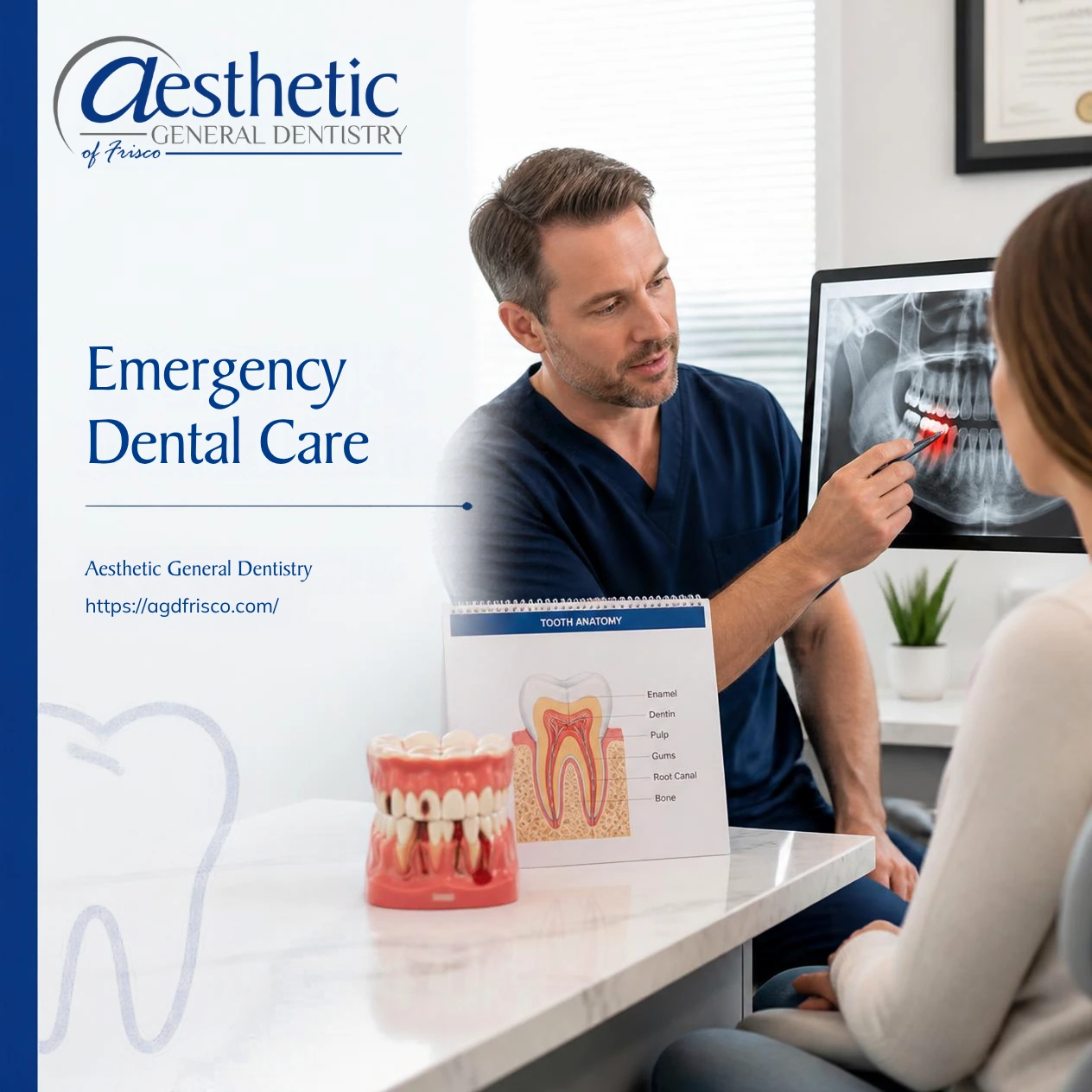
A dental infection can begin inside a tooth or around the gums and potentially spread into nearby tissues if it is not treated.
Possible signs of infection include:
- Severe tooth pain
- Gum swelling
- Facial swelling
- A pimple-like bump on the gum
- Pus or drainage
- Bad taste in the mouth
- Fever
- Sensitivity to pressure
- Tenderness near the affected tooth
A dental abscess will not reliably resolve just because pain temporarily decreases.
Treatment focuses on addressing the source of the infection.
Depending on the tooth and situation, treatment may involve dental procedures, drainage, or tooth removal. Antibiotics may be prescribed in certain situations, but they do not replace treatment of the underlying dental problem.
Warning Signs of a Spreading Infection
Seek immediate evaluation when dental infection symptoms are rapidly getting worse.
Emergency medical care may be necessary if you develop:
- Difficulty breathing
- Difficulty swallowing
- Rapidly spreading facial or neck swelling
- Severe weakness or confusion
- Significant swelling around the eye
- Serious systemic symptoms
These are not symptoms to manage at home.
When Is an Emergency Tooth Extraction Needed?
An emergency tooth extraction may be recommended when a tooth cannot reasonably be saved and delaying removal would prolong severe symptoms or allow a serious problem to continue.
Possible situations include:
- A severely fractured tooth
- Advanced decay with insufficient healthy tooth structure
- Certain significant infections
- Severe trauma
- A non-restorable tooth causing intense pain
However, severe tooth pain does not automatically mean extraction is required.
In some cases, a tooth may be treatable with another dental procedure.
Your dentist will consider:
- How much healthy tooth structure remains
- Whether the tooth is fractured
- The condition of the surrounding bone
- Infection
- Tooth position
- Long-term restorability
- Your overall treatment needs
Dental X-rays and a clinical examination may be necessary before deciding whether extraction is appropriate.
The goal is to address the emergency while preserving a natural tooth when doing so is predictable and appropriate.
What to Do Before You Reach the Dentist
What you do before your appointment depends on the emergency.
For Severe Tooth Pain
Gently rinse your mouth and keep the area clean.
Use over-the-counter pain medication only as directed on the label and if it is appropriate for you.
Do not place aspirin directly against the gum or tooth.
For Facial Swelling
Contact a dental professional promptly.
A cold compress on the outside of the face may help with discomfort in some situations.
Do not attempt to drain or puncture swelling yourself.
For a Knocked-Out Tooth
Handle the tooth by the crown, keep it moist, and seek immediate dental care.
For a Broken Tooth
Save any pieces you can find and avoid chewing on that side.
For Bleeding
Place clean gauze over the area and apply steady pressure.
For a Lost Crown or Filling
Avoid chewing on the affected tooth until it can be evaluated.
Do not use household glue or other non-dental adhesives to reattach a restoration.
Call Before Arriving When Possible
Calling the dental office allows the team to understand the situation and advise you on the next step.
Explain:
- What happened
- When it happened
- How severe the pain is
- Whether you have swelling
- Whether there is bleeding
- Whether a tooth has been knocked out or displaced
- Whether you have fever or other symptoms
These details can help determine how urgently you need to be seen.
When Same-Day Dental Care May Be Necessary
Same-day dental care may be appropriate when waiting could lead to worsening pain, infection, loss of a tooth, or additional damage.
Situations that may need prompt attention include:
- Intense tooth pain
- Rapidly worsening symptoms
- Dental trauma
- Knocked-out permanent teeth
- Displaced teeth
- Large fractures
- Facial swelling
- Suspected dental infection
- Persistent bleeding
- Severe pain associated with a broken restoration
The dentist’s first priority may be controlling pain, evaluating the source of the problem, managing infection, or stabilizing an injured tooth.
Permanent treatment may happen during the same appointment or may require a follow-up depending on the condition.
Do Not Delay Because You Are Unsure Whether It Is an Emergency
You do not need to diagnose the problem yourself.
Call your dental office and explain your symptoms.
The team can help determine whether you should be evaluated immediately, scheduled for a same-day appointment, or seen at another appropriate time.
Get Prompt Help for Dental Emergencies With Aesthetic General Dentistry
Dental emergencies can be stressful, especially when pain, swelling, or an unexpected injury develops suddenly. Knowing which symptoms deserve prompt attention can help you respond before the problem becomes more difficult to manage.
At Aesthetic General Dentistry, we evaluate urgent dental concerns such as significant tooth pain, broken teeth, dental trauma, swelling, and suspected infections to determine the most appropriate next step.
Some emergencies can be treated directly in the dental office, while serious symptoms such as difficulty breathing, difficulty swallowing, uncontrolled bleeding, or rapidly spreading swelling require emergency medical attention.
If you are experiencing an urgent dental problem, contact Aesthetic General Dentistry as soon as possible. Describe your symptoms clearly so the dental team can help determine the appropriate level of care.
FAQs
What is the most common sign that I need emergency dental care?
Severe or rapidly worsening pain is one of the most common reasons to seek urgent dental care. Facial swelling, dental trauma, persistent bleeding, and signs of infection are also important warning signs. The urgency depends on the severity and combination of symptoms.
Should I go to the emergency room for a toothache?
Most toothaches are best evaluated by a dentist because an emergency department may not be able to provide definitive dental treatment. However, seek emergency medical care if the dental problem is accompanied by difficulty breathing or swallowing, rapidly spreading swelling, severe uncontrolled bleeding, or major facial trauma.
Is a broken tooth always a dental emergency?
Not always. A small chip without pain may not require immediate treatment. A large fracture, severe pain, bleeding, tooth looseness, or visible damage extending deeper into the tooth should be evaluated promptly.
Is a dental abscess an emergency?
A suspected dental abscess requires prompt professional evaluation. If swelling is rapidly spreading or you have difficulty breathing or swallowing, seek emergency medical attention immediately.
What should I do if my permanent tooth gets knocked out?
Handle the tooth by the crown rather than the root, keep it moist, and contact a dentist immediately. A knocked-out permanent tooth is time-sensitive, so getting professional care as quickly as possible is important.
Can severe tooth pain go away without treatment?
Pain can sometimes temporarily decrease, but that does not necessarily mean the underlying problem has resolved. Decay, infection, cracks, or inflammation may still require treatment. Severe or recurring pain should be professionally evaluated.
When does dental bleeding become an emergency?
Bleeding that is heavy, persists despite steady pressure, follows significant trauma, or occurs with other serious symptoms requires urgent evaluation. Severe bleeding that cannot be controlled may require emergency medical attention.