

When you need to replace a missing tooth, two common options are a dental implant and a dental bridge. Both can restore your ability to chew, improve your smile, and prevent some of the problems associated with leaving a gap untreated. However, they accomplish that goal in very different ways.
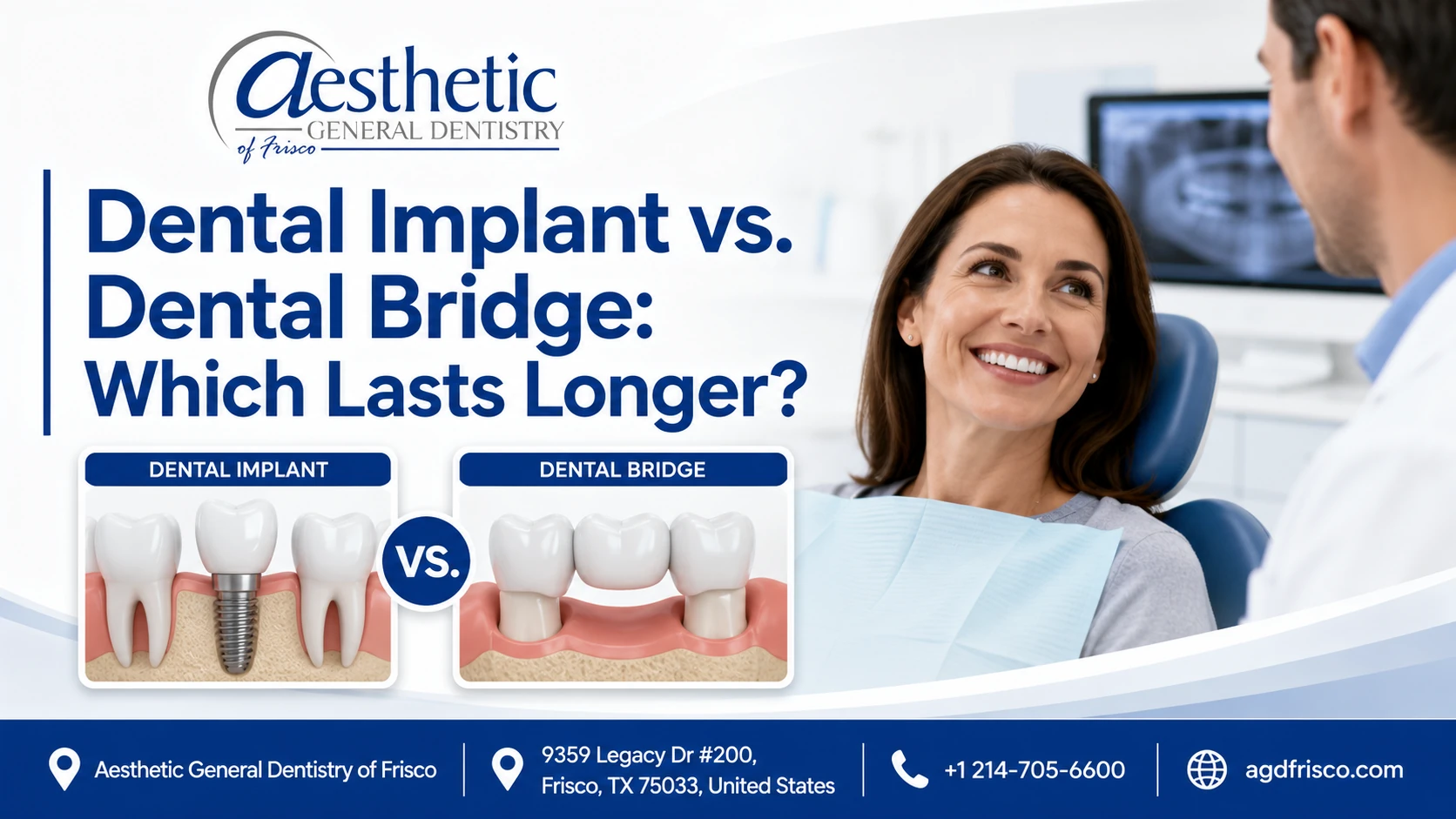
The biggest difference is support. A dental implant uses a post placed in the jawbone to support a replacement tooth, while a traditional dental bridge relies on neighboring teeth for support. The American Dental Association describes implants as posts surgically placed in the jaw that act as stable anchors for replacement teeth. A bridge, by comparison, spans the space created by missing teeth and is attached to surrounding teeth.
If your main question is dental implant vs dental bridge: which lasts longer?, implants generally have greater long-term potential. However, that does not mean an implant is automatically the right choice for every patient or that either restoration is guaranteed to last for life.
At Aesthetic General Dentistry, we consider longevity alongside oral health, bone support, neighboring teeth, bite forces, maintenance needs, treatment time, and budget before recommending an option.
What Is the Difference Between a Dental Implant and a Dental Bridge?
A dental implant replaces a missing tooth independently.
For a single-tooth restoration, the implant itself is placed into the jawbone. After the implant integrates with the surrounding bone, a replacement crown is attached to it. The ADA notes that this integration process can take several months in some cases.
A traditional dental bridge works differently.
Instead of placing an implant into the missing-tooth space, a bridge uses neighboring teeth as its foundation. Artificial teeth fill the gap while crowns or other supporting components connect the restoration to adjacent teeth.
That creates an important difference:
Dental implant
- Anchored in the jaw
- Usually does not require neighboring healthy teeth to support a single replacement tooth
- Includes an implant plus the visible restoration
Dental bridge
- Spans the missing-tooth space
- Relies on neighboring teeth for support
- Does not require implant surgery for a conventional tooth-supported bridge
Neither design is inherently right for everyone. A patient with healthy bone and untouched neighboring teeth may have different priorities from someone whose adjacent teeth already need crowns.
Which Lasts Longer: a Dental Implant or a Dental Bridge?
In general, a well-maintained dental implant has the potential to last longer than a conventional tooth-supported bridge.
The ADA describes dental implants as a long-term option for tooth replacement, while the American College of Prosthodontists also characterizes implants as a predictable, long-lasting treatment.
However, longevity needs to be understood carefully.
A dental implant restoration has several parts. The implant fixture in the bone may remain stable for many years, while the crown attached to it can experience wear or require replacement separately.
A bridge is also durable, but its long-term success depends heavily on the health of the supporting teeth. The ADA specifically notes that a bridge’s success depends on having a healthy and strong foundation.
Neither treatment comes with a guaranteed lifespan.
Factors such as gum disease, decay, oral hygiene, smoking, grinding, biting forces, restoration materials, and routine dental care can significantly affect how long either option remains functional.
How Long Do Dental Implants Typically Last?
Dental implants are designed as long-term tooth replacements.
The implant fixture is made from biocompatible materials and becomes supported by surrounding bone through a process called osseointegration. That connection is a major reason implants can provide strong, stable support.
With good oral health and regular maintenance, the implant itself may remain functional for decades and, in some patients, potentially for life. The American Academy of Periodontology states that with appropriate oral care, implants can have very long-term durability.
That does not mean every component lasts forever.
The crown attached to the implant remains exposed to normal chewing forces and everyday wear. It may eventually require repair or replacement even if the implant underneath remains healthy.
Implants can also develop problems involving the tissues around them. Bacterial buildup can contribute to inflammation around an implant and, if it progresses, loss of supporting bone.
For that reason, an implant should not be considered a maintenance-free artificial tooth.
How Long Do Dental Bridges Typically Last?
Dental bridges can provide many years of successful service, but their lifespan varies considerably.
Rather than assigning every bridge a fixed expiration date, it is more useful to think about the health of the entire restoration and its supporting teeth.
A bridge may eventually need repair or replacement because of:
- Normal material wear
- Decay affecting a supporting tooth
- Gum disease
- Fracture or chipping
- Changes in the bite
- Problems around the bridge margins
- Damage from grinding or clenching
- Failure of one of the supporting teeth
The ADA emphasizes that the success of a bridge depends on the strength and health of its foundation.
This creates an important difference from a single-tooth implant. If one supporting tooth underneath a traditional bridge develops a significant problem, the entire bridge may be affected.
That does not make bridges poor restorations. It simply means their longevity is connected to both the restoration itself and the natural teeth supporting it.
What Factors Affect How Long Each Option Lasts?
The treatment type is only one part of the longevity equation.
Several everyday and clinical factors can influence both implants and bridges.
Oral Hygiene
Plaque and bacteria can affect the gums and supporting structures around restorations.
An implant cannot develop a cavity, but the tissues surrounding it can develop inflammation and peri-implant disease.
With a bridge, the supporting natural teeth remain vulnerable to decay and gum disease.
Gum Health
Healthy gums are important for both restorations.
Inflammation around a bridge can compromise supporting teeth, while inflammation around an implant can progress to bone loss if not appropriately managed.
Grinding and Clenching
Repeated heavy forces can place extra stress on implant crowns, bridges, supporting teeth, and restorative materials.
If you grind or clench your teeth, tell your dentist during treatment planning.
Bite Forces
Where the missing tooth is located can influence how much chewing pressure the restoration receives.
Back teeth generally experience different functional demands from front teeth.
Smoking and Overall Health
Smoking can affect healing and is also associated with greater risk for periodontal and peri-implant problems. The ADA notes that tobacco use can slow implant healing, while the American Academy of Periodontology identifies smoking as a risk factor for peri-implant disease.
Certain medical conditions may also influence implant candidacy and healing.
Regular Dental Care
Both restorations require continued professional monitoring.
Clinical guidelines from the American College of Prosthodontists emphasize ongoing home care and regular professional recall for both tooth-supported and implant-supported restorations.
How Do Dental Implants and Bridges Compare for Maintenance?
Both need daily care, but the cleaning techniques are somewhat different.
Cleaning a Dental Implant
A single implant crown can often be cleaned much like a natural tooth.
Patients generally need to:
- Brush thoroughly
- Clean between the implant and neighboring teeth
- Keep the gumline free of plaque
- Attend regular dental examinations and cleanings
The American Academy of Periodontology specifically recommends regular brushing, flossing, and dental follow-up for implants.
Cleaning a Dental Bridge
Because the replacement tooth in a traditional bridge is connected to supporting crowns, you cannot floss through the space in exactly the same way you would between separate natural teeth.
Cleaning underneath the replacement tooth and around supporting teeth is particularly important.
Your dental team may recommend floss threaders, interdental brushes, water flossing, or another technique appropriate for your specific bridge.
Neither option should be considered “install it and forget it.”
Good maintenance is one of the strongest influences on how long a restoration remains healthy.
How Do Dental Implants and Bridges Compare in Cost?
Dental implants often involve a greater upfront investment than a conventional bridge.
An implant may require multiple stages, which can include:
- Surgical implant placement
- Healing time
- An abutment
- A custom crown
- Additional procedures when needed to improve available bone
A bridge generally avoids implant surgery, although the supporting teeth must be prepared and restored.
However, the lowest upfront cost is not necessarily the lowest long-term cost.
If a bridge eventually requires replacement, or if one of its supporting teeth develops a problem, future treatment can affect the overall financial comparison.
Likewise, an implant may require maintenance, crown replacement, or treatment if complications develop.
Insurance coverage also varies significantly.
Instead of comparing only the initial price, ask for an estimate that explains:
- What is included
- Whether preparatory treatment is needed
- Your expected insurance coverage
- Potential long-term maintenance
- Alternative treatment options
Cost matters, but it should be considered alongside health, longevity, treatment complexity, and personal priorities.
Who Is a Good Candidate for a Dental Implant?
Dental implants may be an option for patients who have good general and oral health, healthy gums, and enough jawbone to support an implant. The American Academy of Periodontology identifies adequate bone and healthy periodontal tissues as important factors in implant candidacy.
A dentist may evaluate:
- Bone volume and quality
- Gum health
- Location of the missing tooth
- Nearby anatomical structures
- Bite
- Medical history
- Smoking or tobacco use
- Healing capacity
- Oral hygiene
Insufficient bone does not necessarily rule out implants. Some patients may be candidates for procedures intended to improve available bone before implant placement.
Age alone is not the deciding factor. The ADA notes that overall health is generally more relevant than age when evaluating implant candidacy.
Certain health conditions or medications may require additional evaluation before surgery.
Who Is a Good Candidate for a Dental Bridge?
A traditional bridge may be appropriate when the teeth next to the missing space can provide adequate support.
Your dentist will evaluate factors such as:
- Condition of neighboring teeth
- Existing crowns or fillings
- Gum health
- Bite alignment
- Number and location of missing teeth
- Available space
- Oral hygiene
- Overall treatment goals
A bridge can be particularly worth considering when adjacent teeth already require significant restorative treatment.
For example, if both neighboring teeth need crowns anyway, using them as part of a bridge may make more clinical sense than it would if they were completely healthy and untouched.
Conversely, one reason some patients prefer an implant is that a single-tooth implant can replace a missing tooth without requiring sound neighboring tooth structure to be removed for a conventional bridge. The ADA specifically mentions preservation of good neighboring tooth structure as one potential advantage of implants.
How Do You Decide Between an Implant and a Bridge?
Start with your oral health, not simply the projected lifespan.
Your dentist will typically consider several questions.
How healthy are the neighboring teeth?
If they are strong and untouched, preserving them may be an important priority. If they already need crowns, a bridge may fit naturally into the overall treatment plan.
Is there enough bone for an implant?
An implant requires adequate support from the jawbone. Bone loss can complicate treatment or require additional procedures.
How quickly do you want the tooth replaced?
Implant treatment can involve a healing period while the implant integrates with the bone, which the ADA notes may take several months for some patients. A bridge can sometimes involve a different overall treatment schedule.
How do you feel about surgery?
Implants involve a surgical component. Traditional bridges generally do not require implant surgery.
What are your budget and insurance considerations?
Upfront and long-term costs can differ.
What maintenance are you comfortable performing?
Both options require excellent hygiene, but the cleaning techniques differ.
Your priorities may make one treatment more attractive, but the final recommendation should also make sense clinically.
What Frisco Patients Should Know About Replacing a Missing Tooth
A missing tooth is more than a cosmetic issue.
Depending on its location, leaving a space untreated may affect chewing, speech, surrounding teeth, and the bone in the missing-tooth area. The ADA notes that neighboring teeth can shift and that bone loss can occur around missing teeth.
For patients in Frisco considering an implant or bridge, the most useful first step is a comprehensive evaluation.
At Aesthetic General Dentistry, we look at the missing tooth as part of your entire bite and oral health rather than recommending a replacement based on longevity alone.
An implant may provide excellent long-term potential for a patient with adequate bone, healthy gums, and suitable overall health.
A bridge may be a strong option when the neighboring teeth can provide reliable support, particularly when those teeth already need restorative treatment.
Neither choice should be reduced to “implant good, bridge bad” or vice versa.
The better question is:
Which option offers the best balance of durability, health, function, maintenance, treatment complexity, and cost for your mouth?
A personalized dental examination can provide that answer much more reliably than a generic lifespan estimate.
FAQs
Which lasts longer, a dental implant or a bridge?
Dental implants generally have greater long-term potential than conventional bridges. However, neither treatment is guaranteed to last for life, and maintenance, oral health, bite forces, and other factors significantly affect longevity.
Can a dental implant last a lifetime?
The implant fixture may remain functional for decades and potentially for life in some patients when supported by healthy bone and gums and maintained properly. The crown attached to it may need replacement separately over time.
Do dental bridges eventually need replacement?
They can. Bridges are durable restorations, but wear, decay of supporting teeth, gum problems, fractures, or changes in the bite may eventually require repair or replacement.
Is an implant harder to maintain than a bridge?
Not necessarily. A single implant is often cleaned similarly to a natural tooth, while a bridge requires careful cleaning underneath the artificial tooth and around its supporting teeth. Both require consistent home care and professional maintenance.
Is a dental implant more expensive than a bridge?
Implants often have a higher initial cost because treatment can involve surgery, multiple components, and additional healing or preparatory procedures. However, long-term replacement and maintenance costs should also be considered when comparing treatments.
Does a dental bridge damage neighboring teeth?
A conventional bridge typically requires neighboring teeth to be prepared so they can support the restoration. Whether that is a disadvantage depends partly on the condition of those teeth. The ADA notes that implants can avoid removing good tooth structure from adjacent teeth in suitable cases.
What happens if a tooth supporting a bridge develops decay?
Because the supporting teeth form the foundation of the bridge, significant decay or damage to one of them can affect the entire restoration. Treatment depends on the location and severity of the problem.
What can prevent someone from getting a dental implant?
Insufficient bone, active gum disease, certain medical conditions, healing concerns, smoking, and other factors may affect candidacy. Some limitations can be addressed before implant placement, while others may make a different tooth-replacement option more appropriate.
Do implants get cavities?
The implant itself and its crown do not develop decay like natural tooth structure. However, plaque can cause inflammation and disease in the gums and bone surrounding an implant, so daily cleaning remains essential.
Which option is faster, an implant or a bridge?
A conventional bridge may sometimes be completed sooner because implant treatment can require a healing period for osseointegration. The ADA notes that implant integration may take several months in some patients.
Is a bridge better if the neighboring teeth already need crowns?
It may be worth considering. If adjacent teeth already require substantial restoration, using them as bridge supports can sometimes fit well with the overall treatment plan. Your dentist must evaluate their strength, gum support, and bite before recommending this option.
How does a dentist decide whether I need an implant or a bridge?
Your dentist considers bone support, gum health, neighboring teeth, bite, medical history, the location of the missing tooth, treatment preferences, cost, and long-term maintenance. A clinical examination and appropriate imaging are usually necessary before making the final recommendation.