

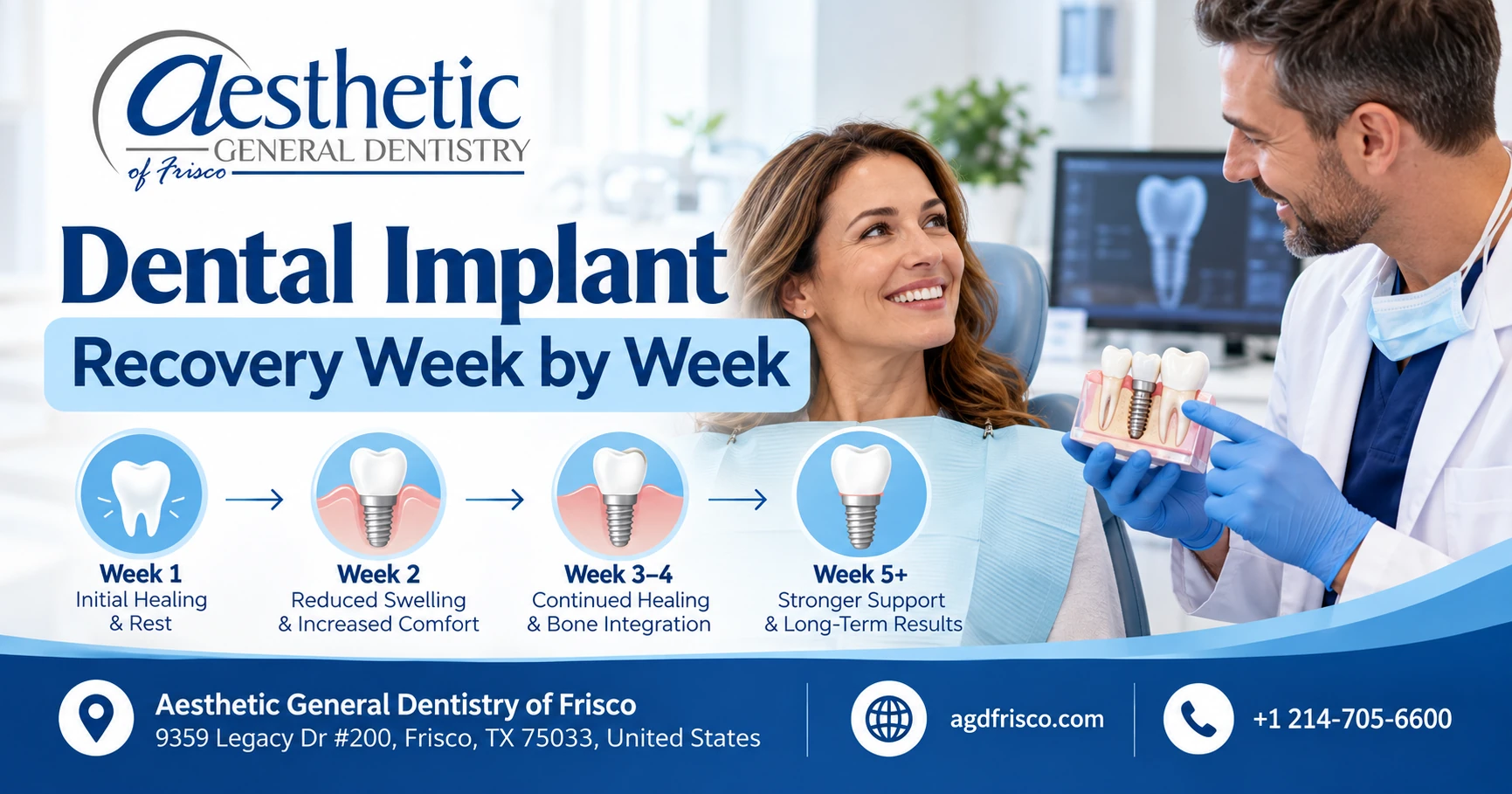
Dental implant recovery usually begins with several days of swelling, soreness, and dietary changes, followed by gradual improvement as the gums heal and the implant integrates with the jawbone. Most patients feel considerably better before the implant itself is fully healed, which can take several months.
Your exact recovery depends on how many implants were placed, whether bone grafting was needed, implant location, overall health, and how your body heals. This week-by-week guide explains common milestones without treating them as fixed deadlines. Patients considering Dental Implants in Frisco, TX should follow the personalized instructions provided by their dental team.
What Should You Expect During Dental Implant Recovery?
Dental implant recovery happens in stages.
The first stage involves healing from the surgical procedure itself. The gums begin closing around the surgical area, swelling decreases, and tenderness gradually improves.
The second stage takes place beneath the surface. The jawbone gradually forms a stable connection with the implant through a process called osseointegration. This stage generally takes much longer than the initial recovery patients can see and feel.
That distinction is important.
You might feel almost completely normal within a few weeks while the implant is still integrating with the bone.
Recovery can also look different depending on your procedure. Someone receiving one straightforward Single Tooth Implant may have a different experience from a patient receiving several implants, bone grafting, an extraction at the same appointment, or other procedures.
Factors that may influence recovery include:
- Number of implants placed
- Implant location
- Whether a tooth was extracted
- Need for bone grafting
- Gum health
- Bone quality and quantity
- Smoking or tobacco use
- Certain medical conditions
- Medications
- Oral hygiene
- How closely postoperative instructions are followed
Your dentist or oral surgeon will give you instructions specific to your treatment. Those instructions should take priority over general recovery timelines.
What Happens During the First 24 to 48 Hours?
The first one to two days usually involve the most active early recovery.
Some soreness, mild bleeding or oozing, swelling, and tenderness around the surgical site can be expected after implant placement.
Swelling
Swelling may not be at its highest level immediately after surgery.
It often increases during the first couple of days before gradually beginning to settle. Some patients also develop mild facial bruising.
Use cold compresses or other swelling-control measures only as directed by your dental team.
Bleeding
Light oozing from the surgical site may occur during the first day.
Your dentist may provide gauze and instructions for controlling bleeding. Avoid repeatedly checking or disturbing the surgical area because this can interfere with early healing.
Persistent or heavy bleeding should be reported to the dental office.
Soreness
Discomfort is expected after oral surgery, but it should generally remain manageable with the pain-control plan provided by your dentist.
Medication instructions vary. Some patients may be advised to use over-the-counter medications, while others may receive prescriptions depending on the procedure and their medical history.
Take medications only as directed.
Eating
Choose foods that require little chewing and are unlikely to irritate the surgical area.
Early options may include:
- Yogurt
- Applesauce
- Eggs
- Smooth soups that are not excessively hot
- Mashed potatoes
- Oatmeal once comfortable
- Soft pasta
- Cottage cheese
- Smoothies eaten with a spoon rather than through a straw
Avoid placing hard or crunchy foods directly around the implant site.
Your dental team may also advise temporarily avoiding very hot foods, spicy foods, alcohol, or foods with small particles that could collect around the surgical area.
Oral Hygiene
Keeping the mouth clean is important, but the surgical area needs to be treated gently.
Patients are often instructed to continue cleaning unaffected teeth while avoiding aggressive brushing directly over the surgical site during the earliest part of recovery.
You may also receive instructions regarding saltwater rinses or a prescribed antimicrobial rinse.
Do not vigorously swish unless instructed to do so.
Activity
Plan for a relatively quiet day after implant surgery.
Heavy lifting, strenuous exercise, or activities that substantially increase your heart rate may increase bleeding or throbbing around the surgical area.
Your dentist can tell you when it is appropriate to resume more demanding activities based on the extent of your procedure.
What Is Normal During the First Week?
The first week is usually when the most noticeable postoperative symptoms begin to improve.
Swelling and tenderness may still be present during the early part of the week, but the general trend should be toward greater comfort rather than increasing pain.
Days Three and Four
Swelling may be more noticeable during the first few days before beginning to decrease.
Mild bruising may also become visible.
The implant area can still feel tender when eating or brushing nearby.
Continue following your prescribed medication and hygiene instructions.
Days Five Through Seven
Many patients begin feeling much closer to normal by the end of the first week.
You may still notice:
- Mild gum tenderness
- Slight swelling
- Bruising
- Sensitivity around the surgical site
- Awareness of stitches
- Mild discomfort when chewing near the area
These symptoms should generally become less noticeable rather than progressively worse.
Continue Protecting the Surgical Area
Feeling better does not mean the implant has finished healing.
Avoid testing the implant by chewing hard foods directly on it unless your dentist has specifically said that is appropriate.
If you have a temporary tooth or temporary restoration, follow instructions about how much pressure it can tolerate.
What About Stitches?
Some implant procedures use dissolvable sutures. Others use sutures that need to be removed during a follow-up appointment.
Do not pull, cut, or repeatedly touch them.
If a stitch becomes loose, contact the dental office if you are uncertain whether this is expected.
What Should Healing Look Like During Week Two?
During the second week, the visible surgical area is often much calmer.
Many patients experience a significant reduction in swelling and soreness, although individual recovery varies.
The gum tissue continues healing around the implant site.
You may be able to return to a broader range of foods, but it is still important to avoid unnecessary pressure on the implant if your dentist has told you to protect it.
Your Follow-Up Appointment
Some patients have a postoperative appointment during this period.
The dentist may evaluate:
- Gum healing
- Sutures
- Signs of infection
- Swelling
- Implant site cleanliness
- Bite
- Temporary restoration, if present
This appointment is also a good opportunity to ask when you can return to specific foods, exercise, or regular brushing around the implant.
Continue Gentle Cleaning
Plaque can still accumulate around a healing implant.
As the gum tissue becomes less tender, your dental team may gradually have you resume more normal cleaning around the area.
Follow their instructions rather than assuming the site should either be completely avoided or scrubbed normally.
The goal is to keep the area clean without traumatizing healing tissue.
What Happens During Weeks Three and Four?
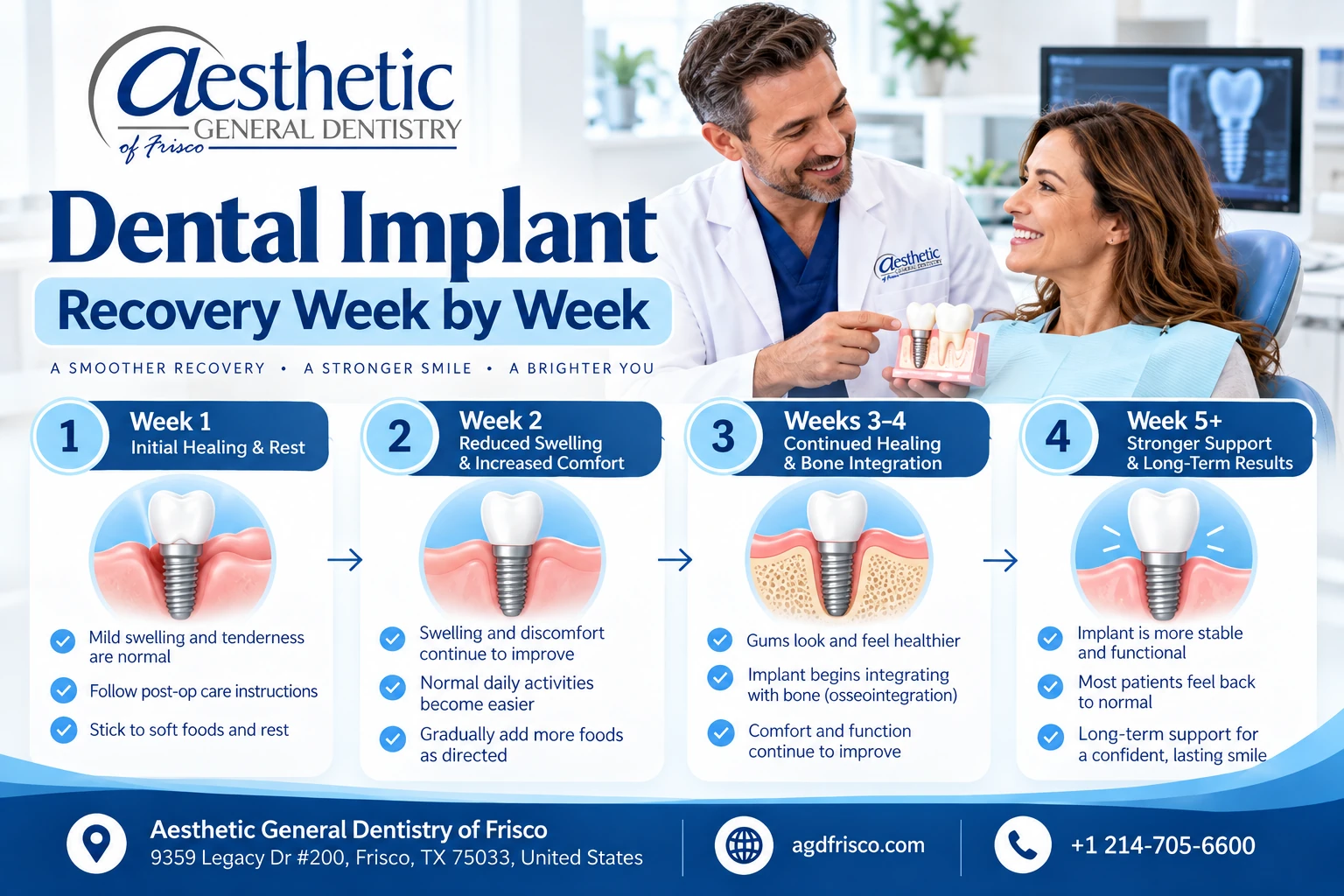
By weeks three and four, many patients no longer feel like they are recovering from surgery.
The gums may appear much more settled, and routine daily activities may feel normal again.
However, an important part of implant healing is still occurring beneath the gumline.
Bone Integration Continues
The implant needs time to develop a stable biological connection with the surrounding bone.
This process does not become complete simply because:
- Swelling is gone
- The gums look healed
- You have no pain
- You can chew comfortably
- You have returned to work or exercise
The implant may still require weeks or months of additional healing before it is ready for the next stage of treatment.
Temporary Teeth Require Care
Some patients receive temporary restorations during implant treatment.
A temporary tooth can improve appearance and sometimes function, but it does not necessarily mean the implant is ready for unrestricted chewing.
Follow the loading and dietary instructions provided by your dentist.
Excessive pressure during early healing may interfere with successful integration in some situations.
What Can You Expect During the First Month?
By the end of the first month, the visible soft-tissue recovery is often substantially complete.
Most patients are no longer dealing with significant postoperative swelling or surgical soreness.
Daily life may feel largely normal again.
However, dental implant treatment is usually not finished at this point.
What May Still Be Happening?
During the first month:
- The jawbone continues integrating with the implant.
- Gum tissue continues maturing.
- A temporary restoration may still be in place.
- Chewing restrictions may still apply.
- Bone graft material, if used, may still be healing.
- Additional follow-up visits may be scheduled.
Some implant systems remain covered beneath the gum during healing, while others have a healing abutment visible above the gumline.
Different implant techniques can therefore look somewhat different during recovery.
Do Not Skip Follow-Up Visits Because You Feel Fine
Dental implant follow-up appointments are not only for patients who have pain.
Your dentist may need to evaluate how the tissues are healing and confirm that treatment is progressing appropriately.
Good early healing can be reassuring, but clinical follow-up remains important.
How Long Does It Take for a Dental Implant to Fully Heal?
Complete dental implant healing often takes several months.
A commonly discussed timeframe for osseointegration is roughly three to six months, but some implants may be ready sooner or require longer healing.
There is no single timeline that applies to everyone.
Healing may take longer when treatment involves:
- Bone grafting
- Sinus augmentation
- Significant bone rebuilding
- Multiple implants
- Certain medical conditions
- Reduced bone density
- Complicated extractions
- Other surgical procedures
Your dentist will determine readiness based on clinical findings rather than simply counting weeks on a calendar.
What Is Osseointegration?
Osseointegration is the biological process through which the jawbone develops direct contact with the implant surface.
This integration provides the foundation needed to support the final restoration.
It happens gradually and cannot be judged by symptoms alone.
A patient may feel completely comfortable long before the dentist considers the implant ready for its final crown or other restoration.
When Is the Final Crown Placed?
Timing depends on the implant’s stability, healing progress, treatment plan, and whether immediate or delayed restoration was selected.
Once the implant has healed sufficiently, the restorative phase may include:
- Evaluating implant stability.
- Preparing or confirming the abutment.
- Taking digital scans or impressions.
- Designing the implant crown.
- Placing and adjusting the final restoration.
For patients replacing one missing tooth, the Single Tooth Implant process is designed to restore that space without relying on the neighboring teeth for traditional bridge support.
When Can You Return to Normal Eating and Daily Activities?
Many routine activities resume much sooner than complete implant healing.
Returning to normal eating, however, should be gradual.
Returning to Work
Some patients return to desk work relatively quickly after straightforward implant surgery.
Others prefer additional recovery time, particularly after more extensive treatment.
If your work involves strenuous physical activity, your dentist may recommend waiting longer before returning to full duties.
Exercise
Light daily activity may be comfortable relatively soon.
More strenuous exercise may need to be paused during early recovery because increased blood pressure can contribute to throbbing or bleeding.
Follow the specific recommendations provided after surgery.
Eating
Diet usually progresses in stages.
You may move from very soft foods to foods requiring moderate chewing as comfort improves.
However, you may still be instructed not to chew hard foods directly on the implant site.
Foods that may need to be temporarily limited include:
- Hard nuts
- Ice
- Hard candy
- Crunchy chips
- Tough meats
- Very crusty bread
- Sticky foods
- Foods requiring aggressive biting
Restrictions depend on whether the implant is buried, has a healing abutment, or supports a temporary restoration.
Do Not Use Comfort as the Only Measure
A lack of pain does not mean unrestricted chewing is automatically safe.
Follow your dentist’s guidance even if the implant feels comfortable.
What Warning Signs Should You Contact Your Dentist About?
Dental implant recovery should generally improve with time.
Symptoms that become progressively worse rather than better deserve attention.
Contact your dentist if you experience:
- Pain that becomes more severe after initially improving
- Increasing swelling after the expected early postoperative period
- Heavy or persistent bleeding
- Pus or unusual drainage
- Fever
- A persistent bad taste associated with the surgical area
- An implant or implant component that appears loose
- Significant difficulty opening your mouth
- New or worsening numbness
- Gum tissue that appears increasingly red or swollen
- Persistent pain when biting
- Problems with a temporary restoration
Do not attempt to tighten or reposition any implant component yourself.
What If Something Just Does Not Feel Right?
You do not need to wait until symptoms become severe before calling.
If your recovery appears different from the instructions you were given, contacting the dental office is appropriate.
Your treatment team knows what was done during surgery and can provide more useful guidance than a generalized recovery timeline.
How Should You Care for Your Implant Long Term?
Dental implants cannot develop cavities in the same way natural teeth do, but the gums and bone supporting them still require consistent care.
Plaque accumulation around an implant can lead to inflammation and, in some cases, disease affecting the tissues surrounding the implant.
Long-term implant care should therefore become part of your normal oral hygiene routine.
Brush Thoroughly
Brush your teeth twice daily using the technique and products recommended by your dentist.
Pay particular attention to the area where the implant restoration meets the gumline.
Clean Between Teeth and Around the Implant
Depending on the shape and location of your implant restoration, your dental team may recommend:
- Dental floss
- Implant-specific floss
- Interdental brushes
- Floss threaders
- Water flossers
- Other specialized cleaning aids
The right method depends on the amount of space around the restoration and the design of the implant crown.
Keep Regular Dental Appointments
Professional examinations allow the dental team to monitor:
- Gum health
- Implant stability
- Bite
- Bone support
- Plaque accumulation
- Crown condition
- Nearby teeth
Professional cleanings are also important for controlling deposits around implants and natural teeth.
Avoid Using Implant Crowns as Tools
An implant restoration is designed for chewing, not opening packages, cracking hard objects, or biting nonfood items.
Avoid habits that could damage the crown or place excessive stress on the implant.
Address Grinding or Clenching
People who grind or clench can place substantial force on natural teeth and dental restorations.
If your dentist sees evidence of grinding, they may discuss ways to manage those forces, including whether a night guard is appropriate.
Recovery Is Shorter Than the Full Healing Process
Dental implant recovery has two different timelines: how quickly you feel better and how long the implant needs to fully integrate with the jawbone.
Swelling, soreness, and dietary limitations are usually concentrated in the earliest stage of recovery. Over the following weeks, the gums generally become more comfortable and daily routines begin returning to normal. Bone integration, however, continues much longer.
That is why postoperative instructions and follow-up visits remain important even when the surgical area no longer hurts.
For patients exploring Dental Implants in Frisco, TX, understanding the recovery process can make treatment feel more manageable. A Single Tooth Implant, multiple implants, or an implant combined with grafting may each follow a somewhat different timeline.
Your dentist can explain what applies to your specific procedure, including when to increase activity, expand your diet, clean around the implant normally, and move forward with the final restoration.
FAQs
How painful is dental implant recovery?
Some soreness and tenderness are expected after implant surgery, particularly during the first several days. Discomfort should generally improve rather than worsen as recovery progresses. Your dentist will provide a pain-management plan based on your procedure and medical history.
How long does swelling last after a dental implant?
Swelling commonly develops during the first few days and then gradually improves. The exact duration varies with the extent of surgery and individual healing. Contact your dentist if swelling continues worsening instead of beginning to settle.
Can I eat normally one week after dental implant surgery?
Some patients can begin eating a wider variety of foods within the first week, but chewing directly on the implant site may still need to be limited. Follow your dentist’s dietary instructions rather than relying on a specific day.
When can I brush the implant area normally?
Cleaning instructions change as the tissues heal. You may initially need to avoid aggressive brushing directly over the surgical site before gradually returning to normal cleaning. Your dentist will tell you when and how to clean the area.
When can I exercise after dental implant surgery?
Strenuous activity is commonly limited during early recovery because it can increase bleeding or throbbing. The appropriate time to return depends on the extent of surgery and how you are healing.
How long before an implant is ready for a crown?
Many implants need several months of healing before the final crown is placed, although treatment protocols vary. Your dentist evaluates implant stability and bone healing rather than relying solely on elapsed time.
Is it normal for the implant area to feel strange several weeks later?
The gums and surrounding tissues may continue adapting as healing progresses. Mild awareness of the area can differ from persistent pain, swelling, or mobility. Contact your dentist if something feels concerning or symptoms are worsening.
Can a dental implant fail during healing?
Implants have high long-term success rates, but complications can occur. Problems with integration, infection, excessive early forces, smoking, health conditions, or other factors may affect healing. Regular follow-up allows your dentist to monitor progress.
Can I chew on a temporary implant tooth?
That depends on how the temporary restoration was designed and how the implant was placed. Some temporary teeth are primarily intended for appearance and should receive limited chewing pressure. Follow the specific instructions provided by your dentist.
When should I worry about pain after implant surgery?
Pain that becomes increasingly severe, returns after improving, or occurs with swelling, fever, drainage, or implant movement should be reported to your dentist.