

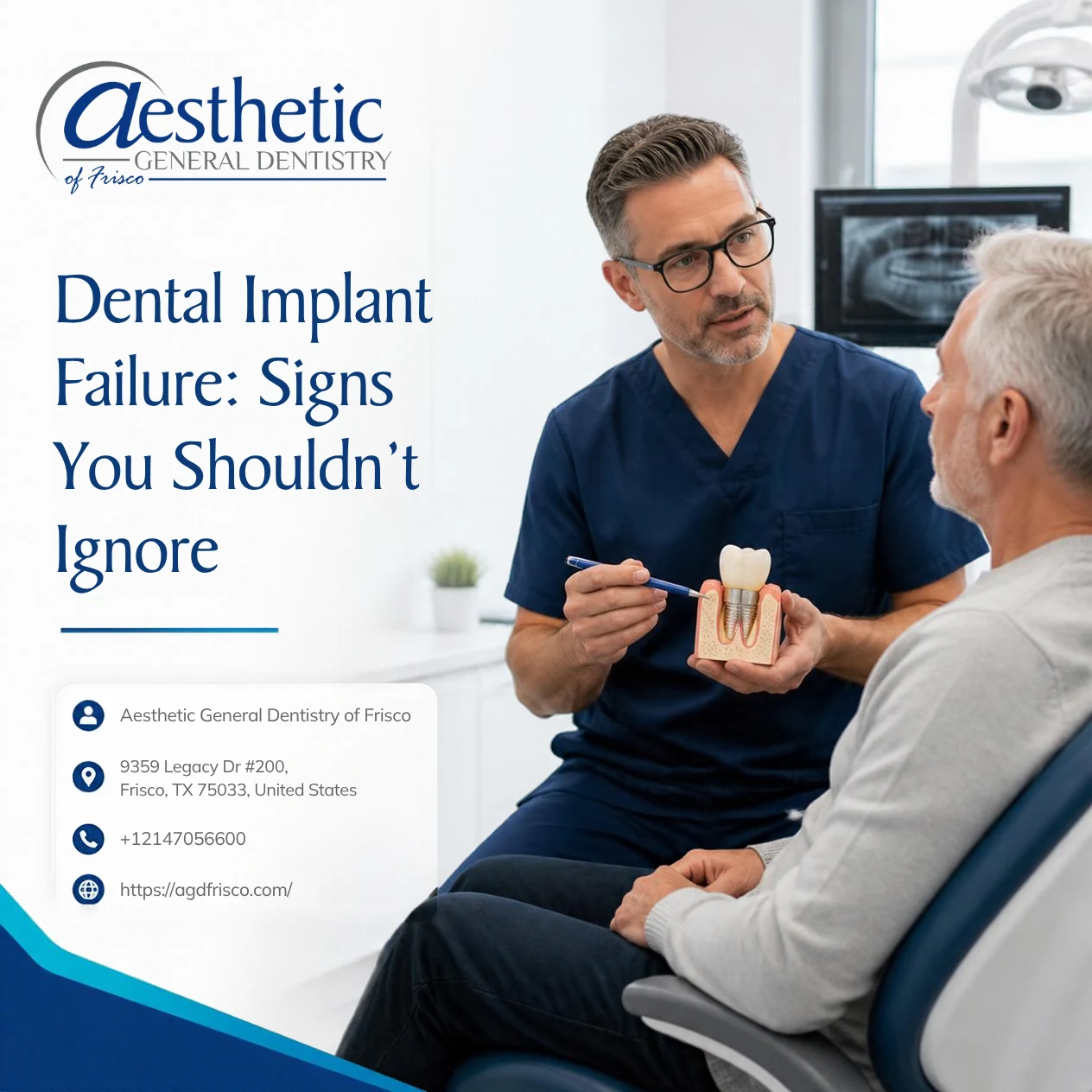
Possible dental implant failure signs can include persistent or worsening pain, implant movement, swelling, bleeding around the gums, drainage, or changes in the way the implant feels when you bite. These symptoms do not automatically mean an implant has failed, but they should be evaluated promptly.
Dental implants are designed to function as stable replacements for missing teeth, but problems can sometimes develop during healing or years after treatment. At Aesthetic General Dentistry, we encourage patients to pay attention to changes around an implant rather than waiting for symptoms to become severe. Early evaluation can help identify whether the issue involves the implant, gum tissue, surrounding bone, crown, or another part of the restoration.
What Are the Signs of Dental Implant Failure?
Dental implant problems can appear in different ways depending on what part of the implant system is affected.
Possible warning signs include:
- Persistent or worsening pain
- Implant movement
- A crown or restoration that feels loose
- Swelling around the implant
- Bleeding gums
- Pus or unusual drainage
- Persistent bad taste or odor
- Gum recession
- Difficulty chewing
- A change in the way your bite feels
- Increasing tenderness around the implant
- Visible changes around the gumline
The timing of these symptoms matters.
Some tenderness, swelling, and mild bleeding can be expected shortly after implant surgery. Those symptoms should generally improve as healing progresses.
Pain or swelling that becomes worse instead of better, however, deserves professional attention.
Problems can also develop much later. An implant that has functioned normally for years may begin showing signs of inflammation, bone loss, mechanical damage, or another complication.
Implant Failure Is Not the Only Possible Explanation
Symptoms around an implant can have several causes.
For example, a restoration may feel loose because:
- A screw has loosened
- The crown has become damaged
- The implant itself has lost stability
- The bite has changed
Those problems are not treated in the same way.
A clinical examination and appropriate dental imaging may be needed to determine what is actually happening.
Is Pain Around a Dental Implant Normal?
Some discomfort can be normal after implant surgery, particularly during the first several days.
Patients may experience:
- Soreness
- Tender gums
- Mild swelling
- Bruising
- Sensitivity while chewing nearby
These symptoms should usually begin improving rather than becoming progressively worse.
Pain During Early Healing
The extent of normal postoperative discomfort depends on:
- Number of implants placed
- Whether a tooth was extracted
- Whether bone grafting was performed
- Implant location
- Individual healing response
Your dentist will provide instructions about pain management and what to expect following surgery.
Persistent Pain Needs Evaluation
Pain that continues longer than expected or becomes more intense may indicate that the area needs to be examined.
Possible causes can include:
- Infection
- Inflammation
- Excessive bite pressure
- Poor healing
- Implant instability
- Irritation of nearby tissues
- Problems involving the restoration
Pain alone cannot diagnose implant failure.
However, discomfort that persists, returns after improving, or is accompanied by swelling, drainage, or mobility should not be ignored.
What Does a Loose Dental Implant Mean?
A dental implant should not normally move once it has successfully integrated with the jawbone.
If something around the implant feels loose, contact your dentist.
The cause may involve different parts of the restoration.
The Crown May Be Loose
An implant-supported crown can sometimes loosen without the implant itself moving.
This can happen if the screw or other connecting component becomes loose.
You may notice:
- Clicking
- Movement when chewing
- A change in your bite
- A crown that feels unstable
This does not necessarily mean the implant has failed.
The restoration may simply need adjustment, tightening, repair, or replacement.
The Implant Itself May Be Mobile
Movement of the implant fixture within the bone is more concerning.
During early healing, mobility can suggest that the implant has not integrated properly.
Later in the implant’s life, movement may be associated with substantial bone loss or another problem affecting support.
Do not repeatedly test a suspected loose implant by pushing it with your fingers or tongue.
Avoid chewing heavily on that area and schedule an examination.
Can Swelling or Bleeding Around an Implant Be a Warning Sign?
Yes. Persistent swelling or bleeding around a dental implant may indicate inflammation in the surrounding gum tissue.
Occasional minor bleeding from aggressive brushing or flossing can happen, but repeated bleeding deserves attention.
Possible warning signs include:
- Red gums
- Puffy or swollen tissue
- Bleeding while brushing
- Bleeding during interdental cleaning
- Gum tenderness
- Pus or drainage
- Persistent bad taste
- Gum recession
Early Inflammation May Be Limited to the Gums
Inflammation around an implant can sometimes begin in the soft gum tissue without significant bone loss.
Early evaluation and improved plaque control may help prevent the problem from progressing.
Worsening Symptoms Can Suggest a Deeper Problem
Inflammation that progresses into the tissues and bone supporting the implant can become more serious.
This is why persistent gum changes around an implant should be evaluated even if the implant does not hurt.
Dental implants do not develop cavities, but the tissues supporting them can still become diseased.
Why Can Bone Loss Affect Dental Implant Stability?
Dental implants depend on surrounding jawbone for support.
During successful healing, bone forms a direct connection with the implant surface through a process called osseointegration.
If enough supporting bone is lost, the implant may become less stable.
What Can Contribute to Bone Loss?
Potential contributors include:
- Inflammation around the implant
- Infection
- Poor plaque control
- Smoking or tobacco use
- Excessive bite forces
- Certain medical factors
- Problems with implant position or restoration design
The exact cause needs to be evaluated rather than assumed.
Bone Loss May Not Cause Early Symptoms
One reason regular dental monitoring is important is that bone loss may progress without obvious pain.
Dental examinations and imaging may identify changes before an implant becomes loose.
A patient may feel that everything is normal while subtle changes are occurring beneath the gumline.
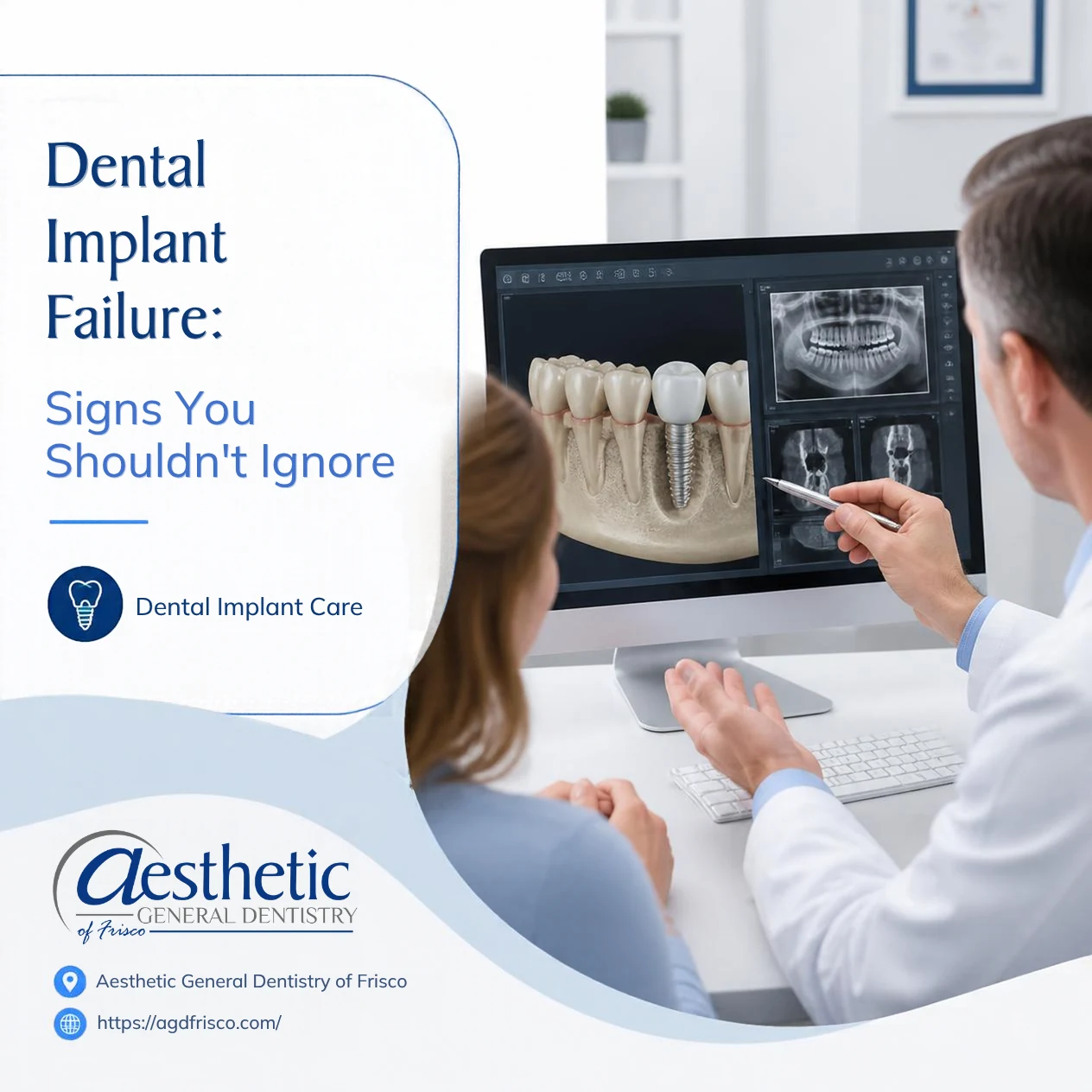
What Causes Dental Implants to Fail?
Implant problems can develop during the early healing period or much later.
Early Implant Failure
An implant may fail to integrate properly with the jawbone.
Potential contributing factors include:
- Poor initial stability
- Infection
- Excessive movement during healing
- Insufficient bone
- Smoking
- Certain health conditions
- Premature or excessive chewing forces
Sometimes an implant does not integrate even when treatment is planned carefully and postoperative instructions are followed.
Late Implant Failure
A previously stable implant may develop problems years later.
Possible contributors include:
- Peri-implant inflammation
- Progressive bone loss
- Heavy grinding or clenching
- Mechanical complications
- Poor long-term hygiene
- Smoking
- Changes in general health
- Problems with the implant restoration
Implant Failure Is Often Multifactorial
There is not always one clear cause.
A patient may have several contributing factors at the same time.
For example, plaque accumulation combined with smoking and difficult-to-clean restoration contours may increase risk more than any one factor alone.
That is why treatment decisions should be based on a full evaluation rather than on symptoms alone.
Can Gum Disease Develop Around a Dental Implant?
Dental implants cannot develop traditional gum disease in exactly the same way natural teeth do because there is no natural tooth root.
However, similar inflammatory conditions can affect the tissues surrounding implants.
These conditions are generally called peri-implant diseases.
Peri-Implant Mucositis
Peri-implant mucositis involves inflammation in the gum tissue surrounding the implant without significant supporting bone loss.
Possible signs include:
- Redness
- Swelling
- Bleeding
- Tenderness
This stage may be manageable when identified early and the contributing factors are addressed.
Peri-Implantitis
Peri-implantitis involves inflammation along with progressive loss of supporting bone around the implant.
Possible findings may include:
- Bleeding
- Swelling
- Pus
- Deepened pockets around the implant
- Gum recession
- Bone loss on X-rays
- Implant mobility in advanced cases
Treatment becomes more challenging as bone loss progresses.
Good Hygiene Still Matters With Implants
Because implants cannot develop cavities, some patients mistakenly assume they require less care than natural teeth.
In reality, plaque control remains essential.
Daily brushing, cleaning around the implant, and professional maintenance help protect the surrounding gums and bone.
Can a Failing Dental Implant Be Saved?
Sometimes.
Whether an implant can be preserved depends on what is causing the problem, how advanced it is, and how much healthy support remains.
Minor Mechanical Problems
If the implant itself is stable but a screw or crown is loose, the dentist may be able to repair or replace the restorative component.
This is very different from a biologically failing implant.
Early Gum Inflammation
When inflammation is limited to the soft tissues, improving plaque control and providing professional treatment may help restore healthier conditions.
Bone Loss Around the Implant
When supporting bone has been lost, treatment can become more complex.
Depending on the case, treatment may involve:
- Professional cleaning around the implant
- Antimicrobial measures
- Adjustment of the restoration
- Bite adjustment
- Surgical treatment
- Bone regeneration procedures
- Removal of the implant
No single approach works for every patient.
Some Implants Cannot Be Predictably Saved
If an implant is significantly mobile, has severe bone loss, or cannot be maintained in a healthy condition, removal may be the safest option.
The area can then be evaluated for future treatment.
When Is Bone Grafting Needed?
Bone grafting may be considered when there is not enough healthy jawbone to support an implant or when bone has been lost around a failing implant.
It may be performed at different stages.
Before Implant Placement
Some patients need grafting before a new implant can be placed because the jawbone is too thin or has lost volume after tooth loss.
At the Time of Implant Placement
In certain situations, a smaller bone defect may be treated during implant surgery.
After Implant Complications
Bone regeneration may sometimes be considered around an existing implant when a suitable defect is present and the implant remains stable.
Other cases may require implant removal followed by grafting before another implant is considered.
Bone Grafting Does Not Guarantee a New Implant
Healing must be evaluated after grafting.
The dentist will consider:
- Bone volume
- Bone quality
- Gum condition
- Implant location
- Medical factors
- Smoking history
- Bite forces
Only then can the next stage of treatment be planned.
When Should You Contact Your Dentist?
Contact your dentist if you notice persistent or worsening changes around a dental implant.
Do not wait until an implant becomes severely painful or obviously loose.
Schedule an evaluation if you experience:
- Pain that does not improve
- Increasing swelling
- Bleeding around the implant
- Pus or drainage
- Persistent bad taste
- Implant movement
- A loose crown
- New gum recession
- Difficulty chewing
- A sudden change in your bite
- Persistent tenderness
- Unexplained changes around the implant
Seek Prompt Attention for Infection Symptoms
Contact the dental office promptly if swelling, pain, or drainage is getting worse.
Significant facial swelling, difficulty swallowing, breathing difficulty, or rapidly spreading swelling requires urgent medical attention.
Do Not Try to Tighten an Implant Yourself
If something feels loose, avoid trying to adjust or tighten it at home.
The problem may involve the crown, screw, abutment, or implant itself.
Professional evaluation is needed to determine which component is affected.
Pay Attention to Changes Around Your Dental Implant
Dental implants can function successfully for many years, but long-term success depends on healthy bone, healthy gums, appropriate bite forces, good oral hygiene, and ongoing professional monitoring.
Persistent pain, movement, swelling, bleeding, drainage, or changes in the bite should not automatically be interpreted as implant failure. They are warning signs that something around the implant needs to be examined.
At Aesthetic General Dentistry, we focus on determining which part of the implant system is causing the problem before recommending treatment. Sometimes the issue is a loose crown or screw. Other cases may involve inflammation, bone loss, infection, or incomplete integration with the jawbone.
The earlier a potential complication is evaluated, the more options may be available.
If your implant has started to feel different, becomes painful, bleeds repeatedly, or feels loose, schedule a dental examination rather than waiting for the problem to resolve on its own.
FAQs
Can a dental implant fail years after it is placed?
Yes. An implant can develop complications years after successful placement due to inflammation, bone loss, mechanical problems, excessive forces, or other factors.
Is it normal for a dental implant to hurt?
Some soreness is expected after implant surgery. Persistent, worsening, or newly developing pain after the implant has healed should be evaluated.
Can a loose implant tighten on its own?
A mobile implant should be examined by a dentist. Do not assume it will become stable again without treatment.
What is the difference between a loose crown and a loose implant?
A crown or connecting screw may move while the implant remains firmly attached to the bone. If the implant fixture itself moves, the problem is more serious. A dental examination can determine which component is loose.
Can bleeding around an implant be normal?
Occasional minor irritation may happen, but repeated bleeding can indicate inflammation and should be evaluated, particularly if it occurs with swelling or tenderness.
Can dental implants get infected?
The tissues surrounding an implant can become infected or inflamed. Peri-implant disease can affect the gums and, in more advanced cases, the supporting bone.
Can bone loss around an implant be reversed?
Some bone defects may be treated with regenerative procedures, but results depend on the amount and pattern of bone loss, implant stability, and other individual factors.
Does a failing implant always need to be removed?
No. Some problems can be treated while keeping the implant in place. Advanced bone loss, severe mobility, or other major complications may make removal necessary.
Can grinding damage a dental implant?
Heavy grinding or clenching can place excessive forces on an implant restoration and supporting structures. A dentist may recommend strategies to manage those forces when appropriate.
How can I lower the risk of implant problems?
Brush thoroughly, clean around the implant every day, avoid tobacco, manage grinding when appropriate, attend regular dental visits, and contact your dentist when you notice changes around the implant.