


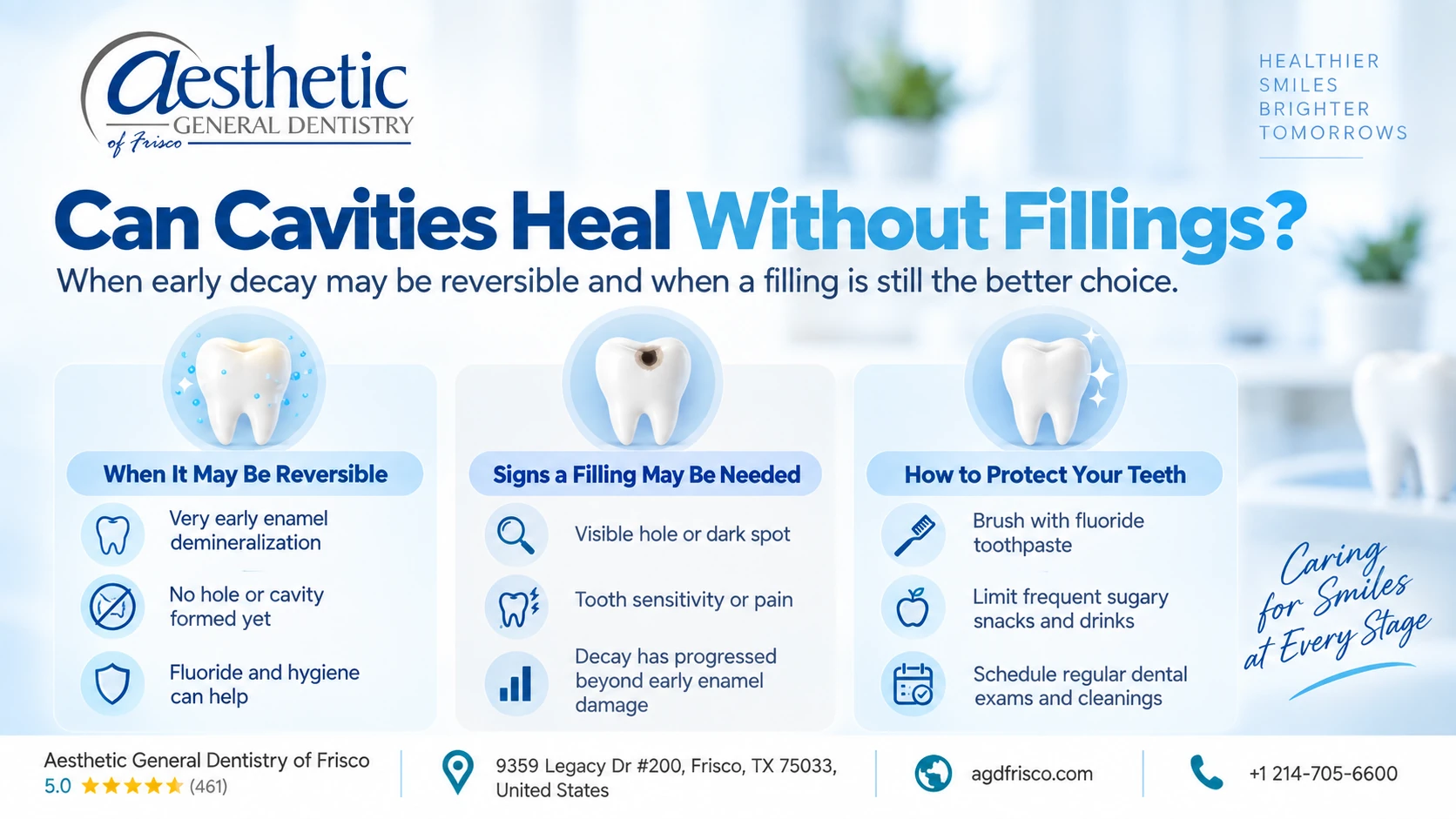
If you are wondering, “Can cavities heal without fillings?”, the answer depends on how far the tooth decay has progressed. Very early decay, before a physical hole develops in the enamel, may sometimes be stopped or reversed through remineralization. Once decay has caused permanent loss of tooth structure and a true cavity has formed, however, the tooth cannot rebuild that missing structure on its own.
Fluoride, good oral hygiene, dietary changes, and regular dental care can help protect weakened enamel and prevent early decay from progressing. At Aesthetic General Dentistry, we encourage patients to have suspicious areas evaluated early because tooth decay is generally easier to manage before extensive damage develops.
Can Cavities Heal Without Fillings?
Very early tooth decay may sometimes be managed without a filling, but an established cavity cannot heal itself.
To understand the difference, it helps to look at how cavities develop. Bacteria in dental plaque use sugars and starches from foods and beverages and produce acids. These acids remove minerals from the tooth’s enamel.
During the earliest stage of this process, the enamel may still be intact. You might develop a chalky or white area where minerals have been lost. At this point, the enamel may be able to regain minerals through saliva, fluoride, and preventive dental care.
The National Institute of Dental and Craniofacial Research (NIDCR) explains that early tooth decay can be stopped or reversed before a hole forms. Once enough enamel has been destroyed to create a cavity, however, the damage is permanent and generally requires dental treatment.
This is why detecting decay early can make such a significant difference.
What Is the Difference Between Early Decay and a Cavity?
Early decay and a cavity are different stages of the same disease process.
Early tooth decay occurs when acids have begun removing minerals from the enamel, but the tooth’s surface has not yet physically broken down. This stage is sometimes called demineralization.
Signs may include:
- A chalky white spot on the tooth
- Changes in enamel appearance
- Mild sensitivity in some cases
- No symptoms at all
In fact, early decay often causes no noticeable symptoms.
A cavity develops when continued mineral loss weakens the enamel enough that part of the tooth structure breaks down. A hole or damaged area has now formed.
Once this happens, remineralization cannot recreate the missing portion of the tooth. The decayed tissue may need to be removed and the area restored with a filling or another type of restoration.
NIDCR describes a cavity as permanent damage that must be repaired once enamel has been destroyed.
Can Tooth Enamel Remineralize?
Yes. Tooth enamel naturally goes through cycles of mineral loss and mineral replacement throughout the day.
When bacteria in plaque produce acids, minerals such as calcium and phosphate can be lost from enamel. Saliva helps neutralize acids and supplies minerals that can return to the tooth surface.
This process is known as remineralization.
Fluoride also plays an important role by helping strengthen weakened enamel and making it more resistant to future acid attacks.
Remineralization can be effective when decay is still limited to its earliest stage and the enamel surface remains intact. It cannot replace enamel that has already broken away or rebuild a physical hole in a tooth.
Think of remineralization as strengthening weakened tooth structure rather than growing a missing piece of tooth back.
How Fluoride Supports Early Tooth Decay
Fluoride is one of the most important tools available for preventing cavities and managing early enamel demineralization.
It can help:
- Replace minerals lost from enamel
- Strengthen weakened tooth surfaces
- Make enamel more resistant to acid
- Slow the tooth decay process
- Support the reversal of early decay before a cavity develops
Fluoride can come from several sources, including fluoride toothpaste, fluoridated drinking water, some mouth rinses, and professional fluoride treatments.
NIDCR notes that fluoride helps reverse early decay by replenishing minerals that have been lost from enamel. The American Dental Association also recognizes fluoride’s role in encouraging remineralization and making enamel more resistant to decay.
For most people, brushing regularly with fluoride toothpaste is an important part of everyday cavity prevention.
Some people with a higher risk of tooth decay may benefit from additional fluoride treatments. A dentist can determine whether these options are appropriate based on the patient’s individual needs.
When Is a Filling Needed for a Cavity?
A filling is commonly recommended once tooth decay has progressed beyond early mineral loss and created a physical defect in the tooth.
During a filling procedure, the dentist removes damaged or decayed tooth tissue and restores the resulting space with a filling material.
A filling may be appropriate when:
- Enamel has physically broken down
- A hole has developed in the tooth
- Decay has progressed into the dentin beneath the enamel
- The damaged area is likely to continue getting larger
- The tooth has symptoms related to decay
Not every suspicious spot automatically needs a filling. Dentists consider the location, depth, activity, and progression of decay when recommending treatment.
Very early lesions may sometimes be monitored and managed with fluoride, improved home care, dietary changes, or other preventive measures.
Once tooth structure has been lost, however, preventive measures cannot restore the missing portion. A dental restoration is generally needed to repair the damage.
What Happens If a Cavity Is Left Untreated?
Tooth decay tends to progress when the conditions causing it continue.
A small cavity can gradually become larger and move through the enamel into the softer dentin underneath. Because dentin is less resistant to decay than enamel, the process may progress more quickly once it reaches this layer.
As a cavity becomes deeper, symptoms may include:
- Sensitivity to cold or hot temperatures
- Sensitivity to sweets
- Toothache
- Pain when biting or chewing
- A visible hole or dark area
- Food repeatedly getting stuck in the tooth
If decay eventually reaches the center of the tooth, bacteria can affect the dental pulp, which contains nerves and blood vessels.
Advanced untreated decay can lead to infection, abscess formation, significant pain, and eventual tooth loss.
Waiting for a cavity to become painful is not a reliable way to know when treatment is necessary. Decay may progress considerably before noticeable symptoms develop.
Can Diet and Oral Hygiene Help Early Decay?
Yes. Daily habits can have a major influence on whether early tooth decay continues progressing or has an opportunity to remineralize.
Brush With Fluoride Toothpaste
Brush thoroughly twice each day using fluoride toothpaste. Pay attention to all tooth surfaces, including areas close to the gumline.
Fluoride toothpaste can strengthen enamel and support remineralization during the early stages of tooth decay.
Clean Between Your Teeth
A toothbrush cannot effectively reach every surface between neighboring teeth. Floss or another dentist-recommended interdental cleaning method can help remove plaque from these areas.
This is particularly important because cavities can develop between teeth where they may not be easy to see.
Limit Frequent Sugary Foods and Drinks
Bacteria use sugars and certain carbohydrates to produce acids that attack enamel.
It is not only the total amount of sugar that matters. Frequent exposure throughout the day can repeatedly expose teeth to acidic conditions.
Reducing frequent snacking and sipping on sugary beverages can give saliva more opportunity to neutralize acids between meals.
Drink Water
Water can help rinse food particles from the mouth. Fluoridated water can also provide ongoing exposure to fluoride.
Keep Up With Dental Visits
Professional examinations can identify signs of decay that may not yet be causing pain or other obvious symptoms.
Home care is essential, but it cannot determine how deeply decay has progressed. That requires a dental evaluation.
How Dentists Detect Early Cavities
Dentists use several methods to look for tooth decay, including visual examination and dental X-rays when appropriate.
During an examination, your dentist may look for:
- White or chalky areas of enamel
- Brown or dark discoloration
- Changes in the tooth surface
- Visible holes
- Areas where plaque frequently collects
- Existing fillings that may be deteriorating
Dental X-rays can also reveal decay that is difficult to see directly, particularly cavities developing between teeth. NIDCR notes that dentists may use an examination and X-rays to identify decay.
Early detection gives your dentist more options.
When demineralization is discovered before the enamel has collapsed, preventive strategies may be enough to stop or reverse the process in some cases. If a cavity has already developed, your dentist can recommend an appropriate restoration before the damage becomes more extensive.
How to Lower the Risk of Future Cavities
Preventing cavities involves reducing harmful acid attacks while giving enamel opportunities to recover minerals.
Helpful habits include:
- Brush twice daily with fluoride toothpaste.
- Clean between your teeth every day.
- Limit frequent sugary snacks and beverages.
- Drink water regularly.
- Avoid constantly sipping sugary or acidic drinks throughout the day.
- Attend routine dental examinations.
- Have professional cleanings as recommended.
- Ask your dentist whether additional fluoride protection is appropriate.
- Address dry mouth or other factors that may increase your cavity risk.
Your personal risk for cavities can change over time. Oral hygiene habits, diet, medications, saliva production, existing dental work, and health conditions can all influence the likelihood of developing decay.
Regular dental visits allow your preventive care plan to be adjusted as those needs change.
When Should You See a Dentist for Tooth Decay?
You do not need to wait for tooth pain before scheduling an evaluation.
Consider seeing a dentist if you notice:
- New tooth sensitivity
- Pain when eating sweets
- Sensitivity to hot or cold foods
- A visible hole in a tooth
- White, brown, or dark spots
- Tooth pain or aching
- Pain when biting
- Food frequently becoming trapped in the same place
- A chipped or weakened tooth
You should also maintain regular dental examinations even when your teeth feel normal. Early decay frequently causes no symptoms.
If you are concerned about a possible cavity, we encourage you to have the tooth examined rather than trying to determine the stage of decay at home. At Aesthetic General Dentistry, the goal is to identify dental concerns early and determine whether preventive care or restorative treatment is appropriate for the individual tooth.
FAQs
Can a Small Cavity Go Away on Its Own?
A very early area of enamel demineralization may sometimes be stopped or reversed before a physical hole develops. Once enamel has broken down and a true cavity has formed, however, the missing tooth structure cannot regenerate on its own.
Can You Reverse a Cavity With Toothpaste?
Fluoride toothpaste can help remineralize weakened enamel during the earliest stage of tooth decay. It cannot rebuild tooth structure once a physical cavity has formed. A dentist can determine whether an area is still suitable for preventive treatment or needs restoration.
How Do I Know If My Cavity Needs a Filling?
You usually cannot determine the depth of a cavity simply by looking at it. A dentist may use a clinical examination and, when appropriate, dental X-rays to determine how far the decay has progressed and whether a filling is necessary.
Can Fluoride Get Rid of a Cavity?
Fluoride can help stop or reverse early enamel demineralization before a cavity forms. It does not fill an existing hole or restore tooth structure that has already been lost.
What Does Early Tooth Decay Look Like?
Early decay may sometimes appear as a white or chalky area on the enamel where minerals have been lost. However, tooth decay is not always visible, and areas between the teeth may be especially difficult to detect without a dental examination or X-rays.
Can Better Brushing Stop a Cavity From Getting Worse?
Better brushing with fluoride toothpaste can reduce plaque and support enamel remineralization, particularly during very early decay. Once a true cavity has developed, brushing cannot repair the damaged tooth. Professional treatment may still be needed.
Does Every Cavity Cause Tooth Pain?
No. Early decay frequently causes no symptoms, and even some established cavities may not hurt immediately. Pain often becomes more likely as decay progresses deeper into the tooth. Regular dental examinations can help identify cavities before they become painful.
Is It Better to Treat Tooth Decay Early?
Yes. Finding decay while it is still limited to early enamel demineralization may provide an opportunity to manage it with preventive measures instead of a restoration. If a cavity has already formed, treating it before it becomes larger can help preserve more healthy tooth structure.